Artists
Curators
BETWEEN SKY AND EARTH
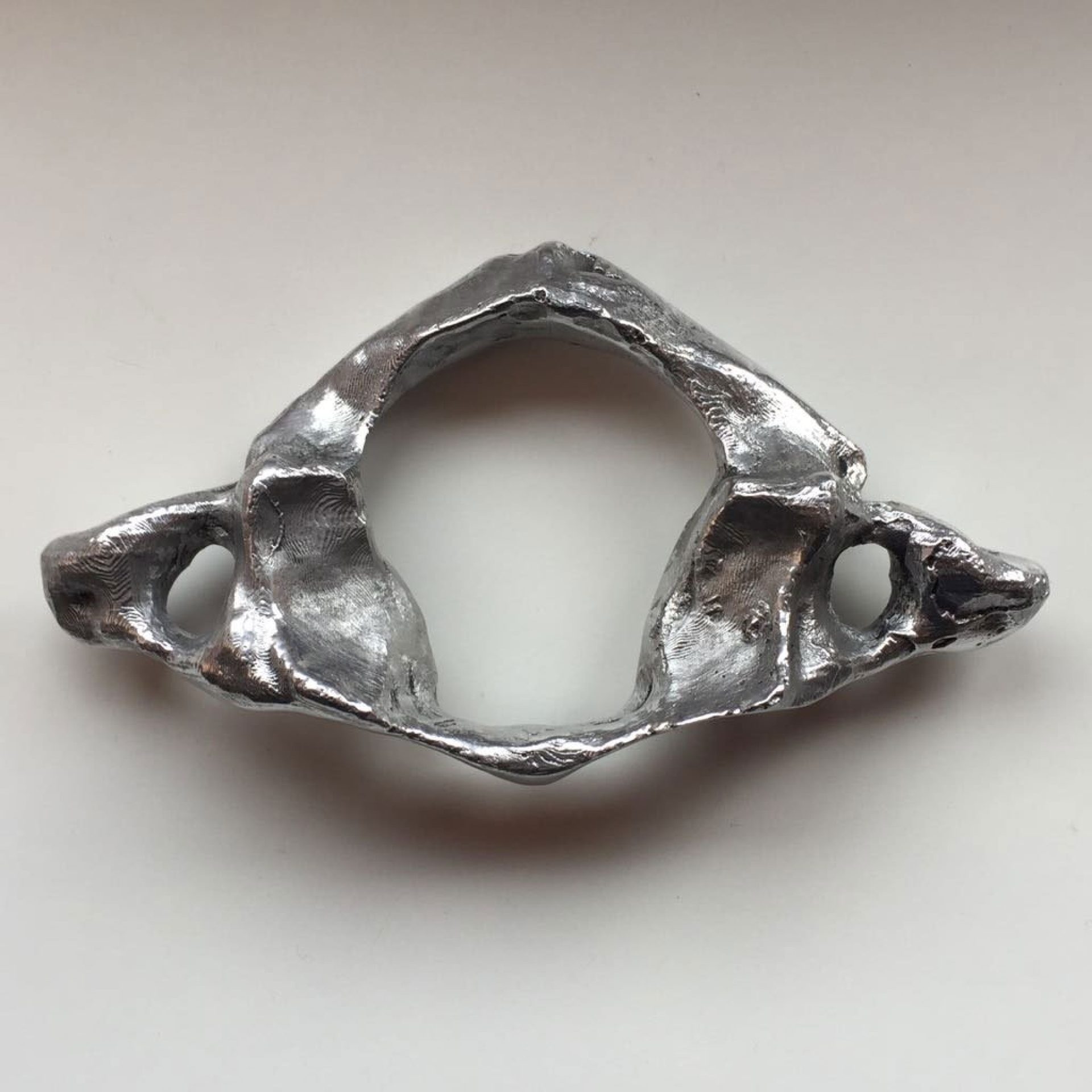
In anatomy, the atlas is the first vertebra, located directly beneath the head. It allows advantageous mobility of the body by forming the joint that connects the skull and spine. Its name evokes the mythological Atlas because just as he supports the world, this vertebra supports and sustains the head. One might then think of the world as having the role of the head. The brain appears as a vibrant buzz of inputs and thoughts, distributed across the thinking space like continents. They move and range independently from their support, carried around by it. They relate to others as if they were other planets. Atlas connects the body to the head, which is certainly part of the body, yet simultaneously soars, seemingly forgetting it. Now I have a separate image of it. My body, however, walks directing the head not only as thought but as a ray of vision and collaboration with others, of interaction. Atlas is called "Telamon," a name also used to designate a volume containing maps or illustrated charts. A translation. Ultimately, the atlas is the gateway for confrontation, the traveler's connection with the place. Abstractly, it becomes the world itself, or the head itself, of which it was only meant to be the support. When it is abstracted, one approaches the idea of a symbol, almost a gateway to imagination. Its structure, however, in Davide Dormino’s work, transforms into matter. In the way most suited to him—sculptural, material, sensitive. The work invades and occupies spaces. Like an idea, it reveals new possibilities. This happens by inscribing a mark within the idea itself because the mark animates the matter. Not flesh, of course, but iron, shiny surface, then paper, opaque world, a line that accompanies and walks alongside forming the drawing. Each material variation reveals new capacities and potential. The line shows the graphic path; you follow the drawing as you follow bones. The human skeleton departs from it, its symbolism is in the role it fulfills. The history of the name and what happens around it peeks through. But it is only a moment before it retreats into thought again. What remains is something that exists, is engraved, alive, and signals the space around it; and by observing it, by entering it, I signal the space around me, signaling that I am tall, wide, deep, I move, I think. All thoughts fly away and are imprisoned in a new form we will call vision. Not exactly an icon, as was said, but rather a brilliant, sculptural aggression of space. A gateway of communication, not alchemical, but visionary between signifiers and meaning. And finally, a site-specific action, purely artistic. An action that invades and breaks through spaces. It measures them, creates a new state of mind, a new environment, traversable with the body. Imprinted on the eye, one might say, and also traversable by the mind, finally visible through the body. Manifestation of a material form. Thought between sky and earth.
Fabrizio Pizzuto
