Artists
Curators
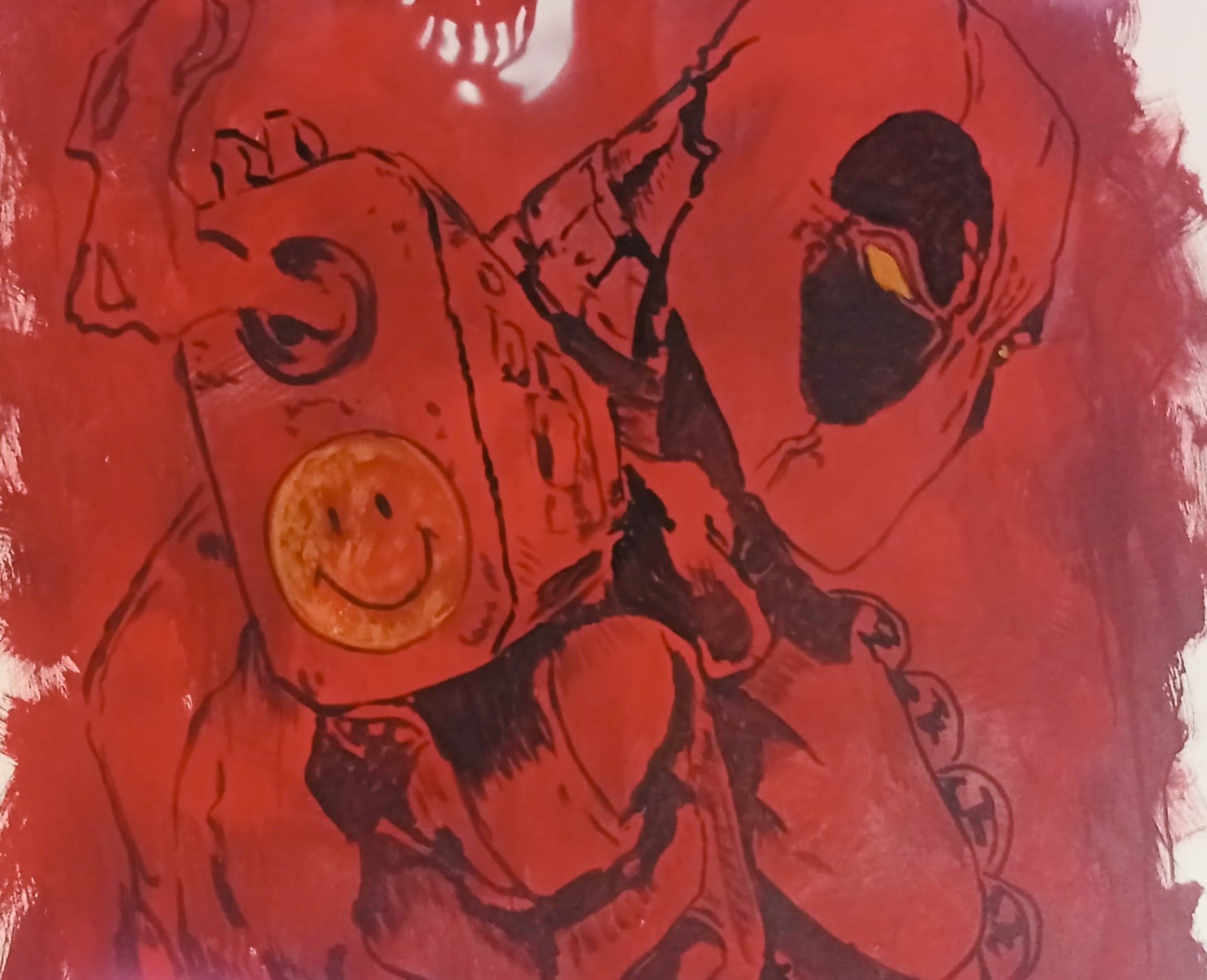
The Border presents a new selection of works by the GAS Collective, structured around a core of about thirteen canvas pieces, accompanied by several sculptures and metal alloy castings. The exhibition develops a compact and immediately recognizable visual universe in which acrylic painting on large canvases, approximately 150 x 100 cm, joins the sculptural presence of three-dimensional works to create an environment of strong symbolic tension.
From its very title, the exhibition identifies the border as its field of action. The Border does not refer only to a geographical or political threshold, but to a broader and more unstable limit: the one between order and disorder, between popular image and disturbing icon, between collective memory and individual reworking, between what society displays and what it would rather remove. In the works of the GAS Collective, the border is never a fixed line; it is instead a zone of friction, passage and collision.
The canvases assert themselves through an intense chromatic force dominated by saturated reds, blacks, whites and violet accents, within a visual grammar that combines gesture painting, stencil, layering, writing and emblematic imagery. Skeletal figures, skulls, repeated symbols, fragments of text and anthropomorphic presences emerge like apparitions within a painting that seems to oscillate constantly between construction and erasure. The image is never offered as a pacified surface: it vibrates, wears out, reappears and imposes itself as the trace of a restless energy.
In this sense, The Border operates on a perceptual and emotional threshold. The works evoke urban language, the aesthetics of rebellion, contemporary visual culture and an almost ritual dimension of the symbol, yet they do so without closing themselves within a single interpretation. The harshness of certain iconographies is continually crossed by an ironic component, by an almost playful theatricality, by a tension that transforms aggression into narrative, the sign into mask and conflict into an image to be questioned. Even when a reference appears direct, the collective bends it toward a more ambiguous field, where the visible never fully coincides with its meaning.
The sculptures and metal alloy castings expand this reflection by transferring it into space. If painting holds the gesture and stretches it across the surface, metallic matter introduces weight, permanence and physical friction. The dialogue between canvases and sculptures thus turns the exhibition into a crossing of coherent yet distinct languages, where the two-dimensionality of the image and the concreteness of the object work together to construct the same atmosphere: tense, compact, unsettling, yet always guided by a strong compositional awareness.
With The Border, the GAS Collective builds a visual landscape in which the border becomes an experience. Not a margin to be contemplated from afar, but a space to inhabit, a critical point where images question categories of identity, strength, fear, power and representation. The exhibition thus invites the public to pause within that intermediate zone where forms do not reassure but reveal; where the symbol does not close meaning but opens it; where art once again becomes a place of impact, freedom and transformation.
