Artists
Marforio: Is it true that all the French are thieves?
Pasquino: Not all, but Bonaparte!
Proposing a reflection on resistance in Rome cannot ignore the centrality of the power the city hosts and represents. In this sense, Iginio de Luca’s interventions must be observed, fully situated in the Roman tradition of mockery and irreverent attacks on authority, from the talking statues to Petrolini.
As Pasquino’s heir, de Luca roams the city to expose the powerful, leaving traces of his passage through an ironic portrait of the Church and Italian political class. The act of resistance is twofold: the message and the action in which Iginio is a protagonist. His disenchanted approach subverts the illusion of political communication, aware that “the security of power is based on the insecurity of citizens” (Leonardo Sciascia, Il cavaliere e la morte, Adelphi, Milan 1988). In this way, the artist, mutatis mutandis, acts as a contemporary Robin Hood or Zorro, a not entirely masked hero whose urban interventions express a sense of responsibility—while enjoying playfulness—highlighting the often dependent nature (even in protest) of the average Italian.
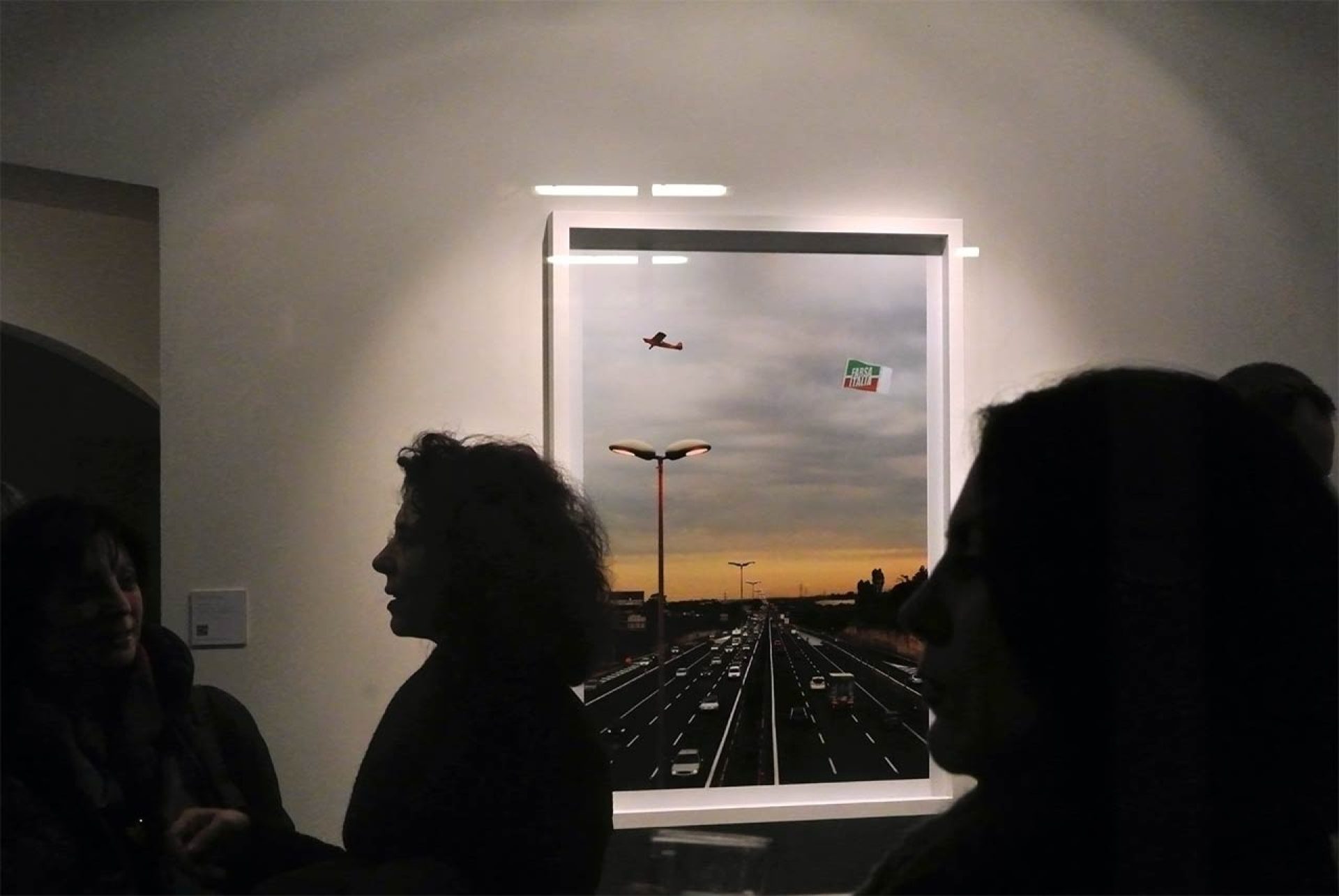
The artist positions himself as a vector of resistance, participating actively in the country’s political scene, which is neither the propagandist activism of muralists nor pure street art guerrilla, though references can be found, as Franco Speroni notes (VisualizzAzioni, Livello4, Rome 2012). His participation involves an open dialogue with political news, with planned reactions to statements and events from palace or party. Thus, Farsa Italia, an aerial blitz carried out on October 13, 2011, on the Grande Raccordo Anulare in Rome, was later exhibited at the end of 2012, coinciding with another media campaign by Berlusconi, aiming to run for the 2013 elections.
The renewed relevance of the wordplay on the old Forza Italia flag dropped from the plane is evident, expressing a generalized and consolidated farce. After the raid—presented in a tightly edited video with compelling sound, suitable for a “lone avenger”—the flag on display becomes a trophy, a war booty. After flying over the skies of Rome, captured at sunset in a postcard-like image, it is exhibited rolled up so that only the tricolor emerges: almost a sign of momentary conquest.
Gallery


