Artists

Those who have experienced a severe personal trauma or a catastrophe perceive time in a completely different way compared to the norm. For them, time unfolds in two opposite directions: before the event and after the event. This has decisive consequences. Before comes dream, joy; afterwards, one lives in a state of anticipation of the event’s repetition, so the remaining time seems unfairly earned, stolen, scraped moment by moment from the post-event time, from future time. It is the time of survivors, who wonder what mysterious merit allowed them to be spared while relatives and friends were taken. For those who remain, any amount of time becomes precious. Thus, echoing Zeno’s paradox, with meticulous counting before the next occurrence, one lives a homeopathic time, subtracted and distilled moment by moment from the event that has occurred—in this case, the L’Aquila earthquake—but could repeat.
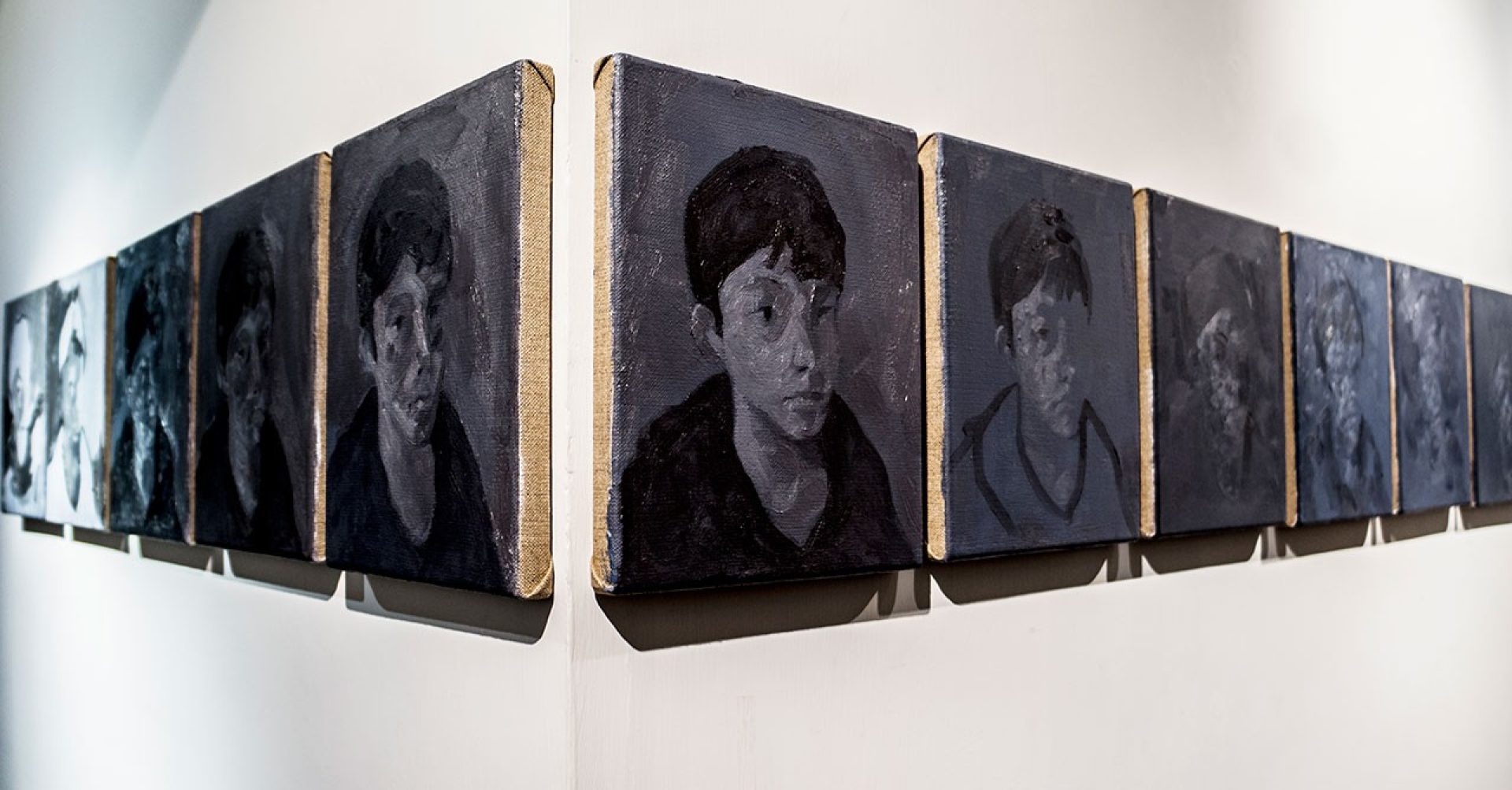
This is the approach of Andrea Panarelli, who feverishly paints his son’s face twenty-nine times. This time is too brief to record any variations, even in the mutable face of a teenager. Therefore, these faces more truthfully reveal another face, that of the father, who through these variations on a theme reflects in his son’s face and teaches us much about him. These portraits are not an album of a face but the diary of the hand that created them, and through this marvelous seismograph of the soul, the variations in the father/son relationship find a way to record ever-different notes in the notebook of affection and to wish for a future free from traumatic fragmentations, a life without catastrophes.
We live in fragile times. Andrea Panarelli’s portraits speak of differences too rapid to be (an)noted; they speak of the contest between the instant and the eternal, the contest of the Futurists, of Rembrandt painting his companion Saskia, of Monet competing with reflections. They speak of us, glimpsed only in a fleeting vision from the eye of eternity, visible only while trembling in appearances. Volatile like L’Aquila.
