Artists

Curators

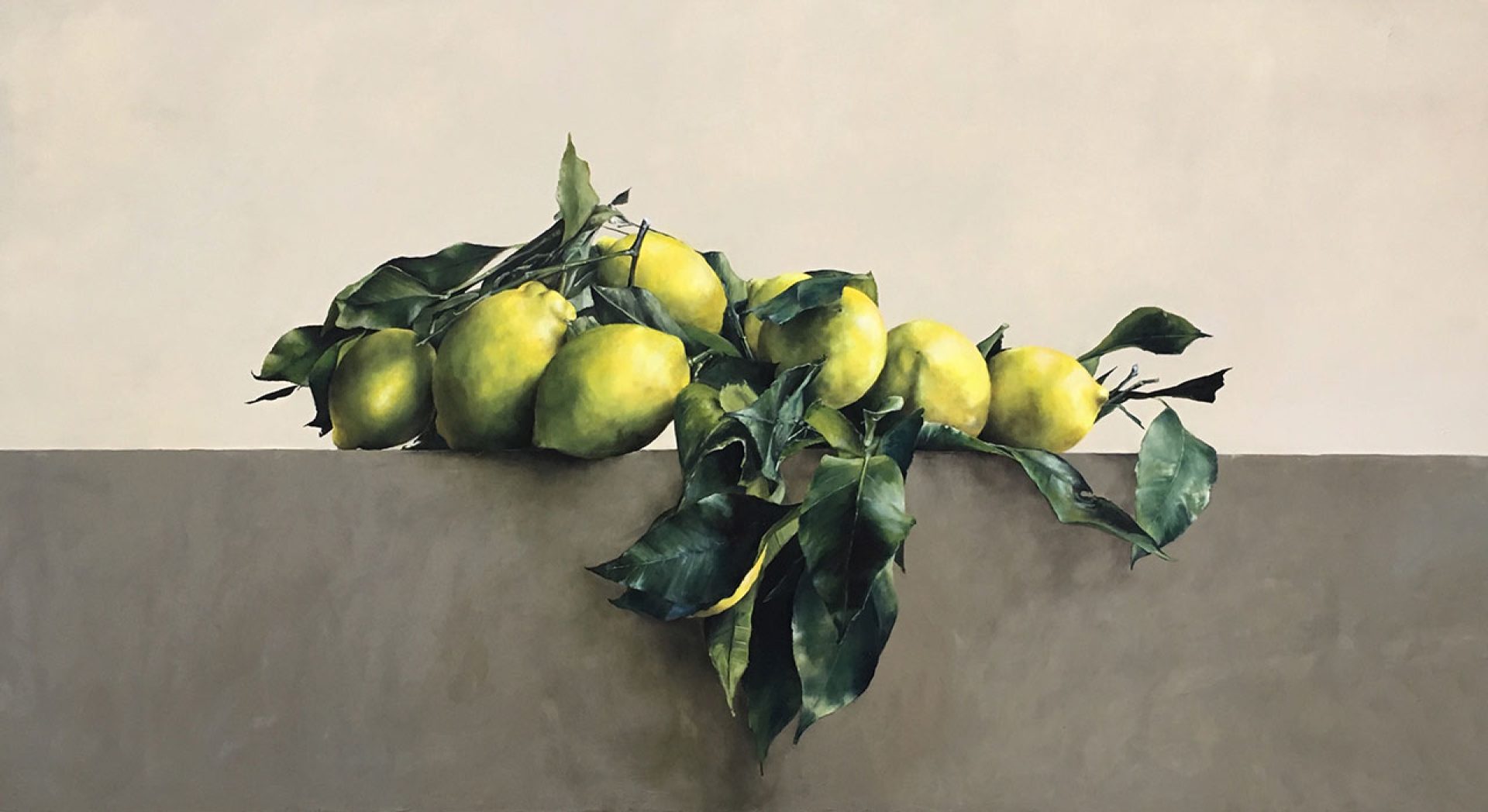
With a recent past devoted to mastering refined decorative techniques, followed by an internship as a theater set decorator, Costanza Alvarez de Castro approaches easel painting from a diametrically opposite perspective: the near absence of background. Whether it is a portrait, the depiction of a fruit, or an animal, the background is simply neutral: not aseptically neutral, nor symbolically or historically so, like the ‘dark’ Caravaggesque backgrounds whose realistic interpretations she approaches with a modern spirit. The background in her paintings envelops, absorbs, supports, and keeps the subjects alive, elevating them to contemporary icons, stripping them of environmental context to highlight their vital, pulsating essence.
Those familiar with Art History might be tempted to associate the style of some of her paintings with a particular chronological or stylistic context: the sixteenth-century Flemish or Lombard still life, the neoclassical or early twentieth-century portraiture, or contemporary metaphysics. However, her subjects emerge beyond these environments, while remaining subtly connected to them.
From her bond with the past, she retains the oil painting technique, which she skillfully adapts through continuous research of effects. The choice to paint in oil is far from obvious. This medium is complex in its layering, glazing, slow drying times, and varied application methods that allow for nuances, and plays of opacity and clarity to which the contemporary eye is no longer accustomed. To this complexity, the artist gives new potential, using an ancient technique in a contemporary key, while respecting, with skill and humility, its slow and intricate processes.
Her subjects are simultaneously abstract and realistic, captured in a timeless, spaceless environment, yet tangible in their physicality and the meticulous details of each element: the brightness of a pomegranate, the expression of a face, the softness of a hare’s fur. These details are not easy to achieve in oil, especially when interpreting the technique apart from past examples. Her portraits convey a fresh, immediate, and timeless quality, even when the figures wear contemporary clothes. Fruits and animals are rendered in a nearly hyperrealistic way, yet without the photographic effect typical of such works.
The recent series of paintings titled “Rainforests” takes a completely different direction: here, the background predominates, serving both as scenography and subject. It is not easy to combine these two elements in a work meant to represent both a cherished moment for the artist—thus, a subject—and a natural landscape—thus, a kind of natural scenography. These paintings present themselves as works where the physical subjects of previous paintings are merged with nature or even absent, and the way the landscape is depicted reveals not only a naturalistic subject but also a particular fragment of the artist’s soul, expressing a deliberate choice to blur and simultaneously elevate the background as a new subject.
The great quality of her paintings lies in combining meticulous detail with the solidity of her figures, executed with a texture that is both dense and crystal-clear, reflecting a refined technique always in search of new solutions.
Christina Underhill Danielli
