Artists

Curators

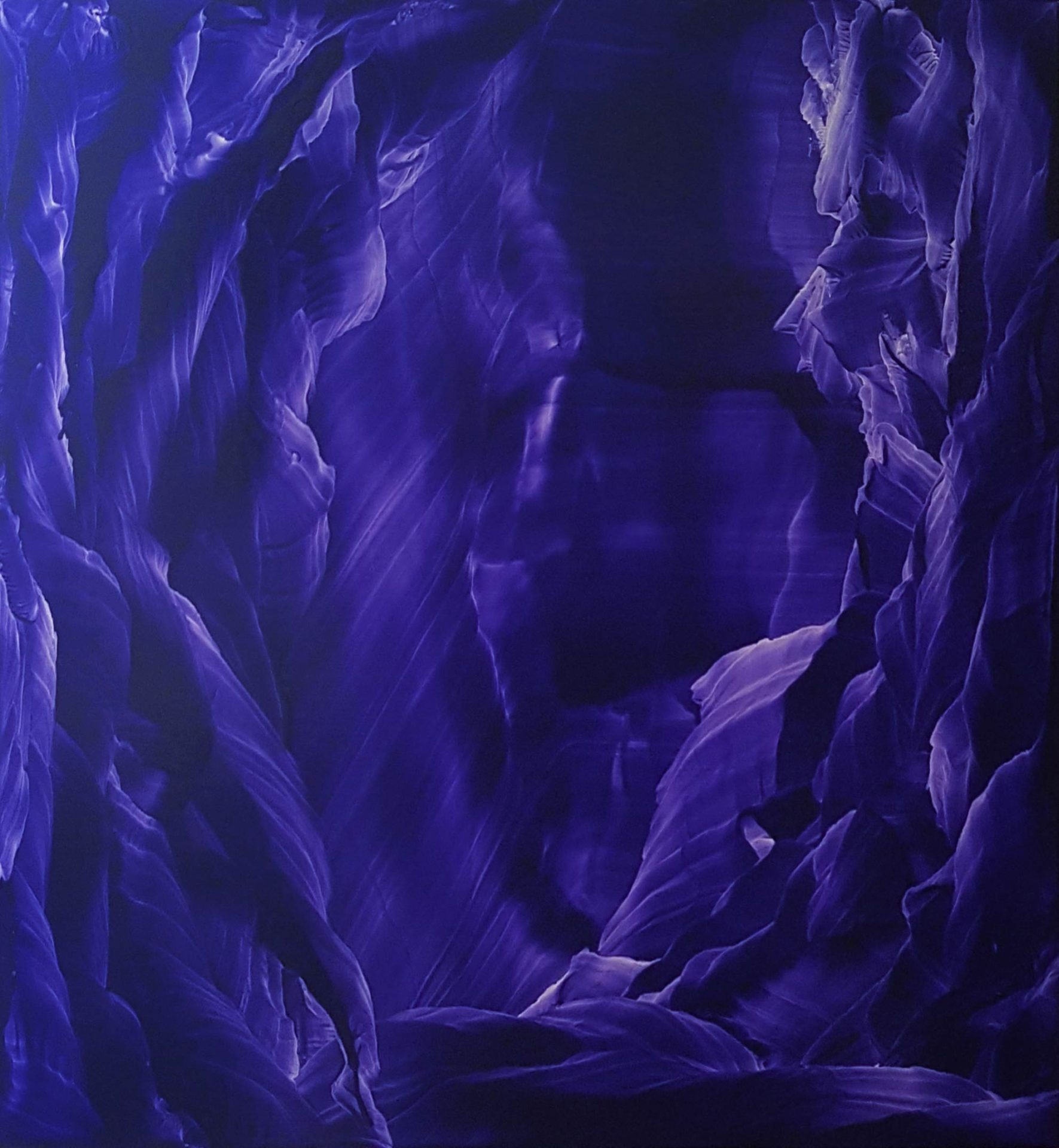
On Thursday, December 15, Spazio Menexa inaugurates the exhibition “Speco” by Mario Nalli, a representation of rocky caves through the artist’s pictorial technique. It evokes the discovery of hidden, intimate spaces concealed within the innermost self. His monochromatic oil paintings describe the enclosed and solitary spaces of nature, interpreted as soft, disorienting drapes.
The critical text, written by Gianni Garrera, notes that “Mario Nalli achieves absolute equivalence between the folds of a rock and those of a brocade, between the scrolls of limestone and cloth. If the first inspiration refers to the walls of Plato’s cave, where images (that is, shadows) of ideas should be reflected, here no idea is reflected: the images or ideas are the folds and jagged edges of the rock itself, which does not act as a screen but is itself a jewel.”
The artist retraces his own path; to complete the exploration, he must delve into his own cave and descend deep within. He unveils the hidden, silent part, revealing that inner strength is necessary to reach it—a solitary mental journey leading to the depths of the cave, where the authentic, primordial soul rests, enveloping us in a light, ephemeral dance of drapery.
Mario Nalli is the seventh artist to participate in Spazio Menexa’s “Salto_nel_buio” cycle of exhibitions, exploring “the most hidden and mysterious spaces of the self.” Drawing from the dramatic movement of emotions, he transports the viewer into his harmonious, gentle, and mutable world, revealing the opening of a space that words cannot describe—a dimension where the blurred space mirrors the strength found within each of us.
The exhibition continues until February 17, 2017.
IN THE CAVE OF PAINTING
As Deleuze wrote, if beauty is made of folds, then the Baroque is right to endlessly produce them, to curve and recurve them, to multiply them infinitely—fold upon fold, fold within fold. When the ornamental justification of the world becomes mutual emulation between attitudes of matter, a rock equals a fabric, both sharing the same aesthetic destiny and undergoing the same ornamental vicissitudes. Mario Nalli achieves absolute equivalence between the folds of rock and brocade, between the scrolls of limestone and cloth. If his first suggestion recalls the wall of Plato’s cave, where images (that is, shadows) of ideas should appear, here no idea is reflected: the folds and jagged edges of the rock are themselves the ideas—no screen, but a jewel. The entanglement exercises its own perspective; inflection finds its reason for being. Folding is a generative power of ornamentation. The cave has no windows, thus it is a monad, not born from Leonardo’s “Virgin of the Rocks”, which is full of openings, but wrinkled and twisted within itself—its only expansions being brighter, more relaxed zones. The twists of the inner material turn inward, away from the open world, in a continuous series of corrugations. The cave’s closure is a closure to the world, an absence of world. The cave is unilateral, obtuse, primordial—it shows only one face. Its wall is a bordered, docile membrane; its façade extends across the entire painting. Contrary to Galileo’s claim that Nature does not delight in poetic appendages, matter continuously yearns for itself or for a supplement of itself. Painting transcends the incidence and immanence of reality. Even if folds retain their naturalness, all reality is aesthetic insofar as it delights in itself and in the folds it can take. Everything in the painting is made of the same aesthetic matter, under the primacy of appearance. The painted object partakes only of the color that paints it, assuming a chromatic substance—an immaterial, pictorial matter, just as in dreams there is a flesh that is dreamlike, not corporeal. In painting, all is pictorial. Nalli pursues a conception of imitation that never duplicates or replicates reality. Representation is configured according to its own physical modality, through which painting can elaborate alternative realizations that, being concrete, are physically distinct from the natural world. These are not walls referring to real space, but purely pictorial bodies. When real things are perceived through such a principle, they lose immediacy and become lyrical appendages.
Painting precedes Nature. Nalli overturns the relationship between appearance and reality. The painted image precedes the natural thing, for if things are made in the image and likeness (Genesis 1:26), then image precedes the being of things themselves.
This painting is not illusionistic art confronting things to simulate them. Its aesthetic reflection does not imitate the sensible appearance of the corporeal, but its paradigmatic essence.
There is a mimetic fiction that is not truly mimetic. At the peak of this ambiguity, Nalli’s painting annihilates its relationship with the rest of the world.
Painting coincides with innate matter. What arises in Nature manifests as imitation of a pre-natural aesthetic principle. The identification of artistic representation with ideal matter goes so far that rocky material translates materially into stone and equivocally into fabric or canvas.
Artistic form preexists the thing before it takes material shape; it transcends the choice of matter that will embody it. Thus, at the origin, there is only pictorial, aesthetic matter. Figuration is superior to and separate from concrete matter. Each painting refers to natural things before their participation in the sensible world. In this sense, Nalli is Platonic: through his caves, he pays homage to all Platonism. It is not art that imitates Nature, but the reverse. In this sense, the entire world is subject to painting.
Gianni Garrera
