Artists

Curators
On March 6th at Spazio Menexa, in the heart of historic Rome, it will be possible to visit an exhibition that will not leave anyone indifferent, attempting to challenge ancient fears, old taboos, and unshakable dogmas.
It concerns the “body” — both social and individual — and practices of control and manipulation that continue to violate and mortify it today, in an attempt to derail the species and make man captivus, docile and knowable, to control his pleasure and intimacy.
While human rights strongly fight against female genital mutilation, little is said about male neonatal circumcision, the oldest and most widespread practice in the world. Today, there are over 600 million circumcised men worldwide, and perhaps the global ethical discussion has not adequately addressed the issue, leaving judgment to faith and ancient beliefs.
This is the starting point for Enzo Aiello’s research, who questioned whether it is ethical to perform circumcision on a newborn, causing a trauma that the mind will never forget and depriving the body of an important part, without justifiable medical reasons. The aim is to open a possible discussion, giving space particularly to voices advocating that circumcision should not be neonatal, but a conscious choice made by adult men.
Thus, Enzo Aiello, supported by the Italian-American organization Foregen, began a path of awareness and research on the subject, and with an almost scientific approach and method, studied the circumcision technique with the simple objective of showing the real magnitude of the censored part of the male human body.
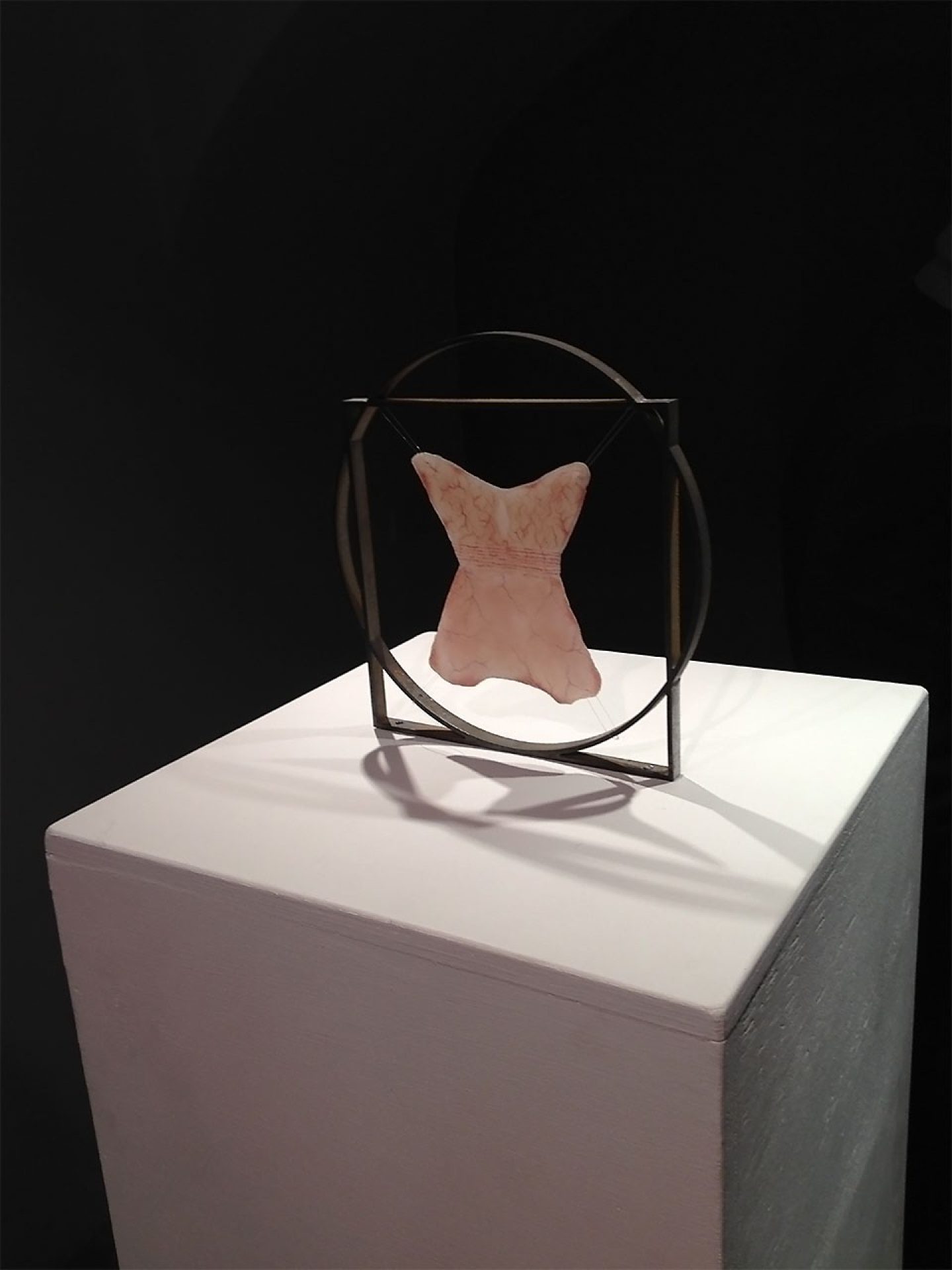
The result is impressive, and this is what HUFO represents.
A sculpture light in form but heavy with conceptual density, metaphors, and references, in an executive and mental process spanning from Renaissance thought to Body Art — as cited in the curator’s text by Lorenzo Canova.
The contemporary artistic references identified by the curator are many: from the mutilations and self-inflicted wounds of Viennese Actionists, Gina Pane to Marina Abramović, to the surgical dimension of artists like Orlan or Franko B, not to mention the silicone orthopedic devices of Matthew Barney and the hyper-real, distressing illusionism of Ron Mueck’s figures.
With disorienting (hyper)realism, Enzo Aiello has recreated the removed foreskin, shaping a full-round sculpture framed within Vitruvian geometric proportions, where it automatically becomes the “measure of all things.”
The effect is intentionally hallucinatory and unsettling, precisely because of the strict classical harmony of the structure, making the sculpture raw and almost violent, like a hunting trophy or a specimen in an anatomical museum.
Thus HUman FOreskin, in its iconic and dramatic presence, transforms into a hypothesis for reflection, a research proposal, and an open, dialectical model in which, as in any true work of art, differing and divergent thoughts can converge, creating a space for discussion where, from now on, the issue can no longer be ignored or forgotten.
