Artists

Curators

It is a beautiful and evocative idea by Micaela Legnaioli, who reintroduces the ancient formula of the Portrait, completely unsettling the viewer.
The artist states that she intends to produce a series of works that have, precisely, the meaning of a Portrait of specific individuals; and these images she proposes must possess all the most typical characteristics of the Portrait: the precise recognizability of the individual, the identification of their specific identity, the highlighting of what is unique and incomparable, in a certain sense, in their personality.
This is where the paradox emphasized by the author arises, who explains her procedures with logical rigour and clarity, outlining the criteria with which she has worked and continues to work. But the paradox is that the aspect the artist highlights in her type of Portrait of the subject is not the physiognomy but rather the fingerprint, or even just one part of it. And there is no doubt, as established by Science, that fingerprints are all different even if structured along similar directions. Moreover, it is known that there are broad categories within which the main types of fingerprints can be circumscribed, but such categories are very complex and difficult to define. Here, the second aspect of Micaela Legnaioli’s creativity emerges: intuition.
It is true that the works she produces based on that premise might be incomprehensible if the author did not clearly explain what those premises are, but it is equally true that once the artist’s creative strategy is understood, the viewer can embark on that journey with delight and curiosity, combining scientific awareness with immediacy of perception.
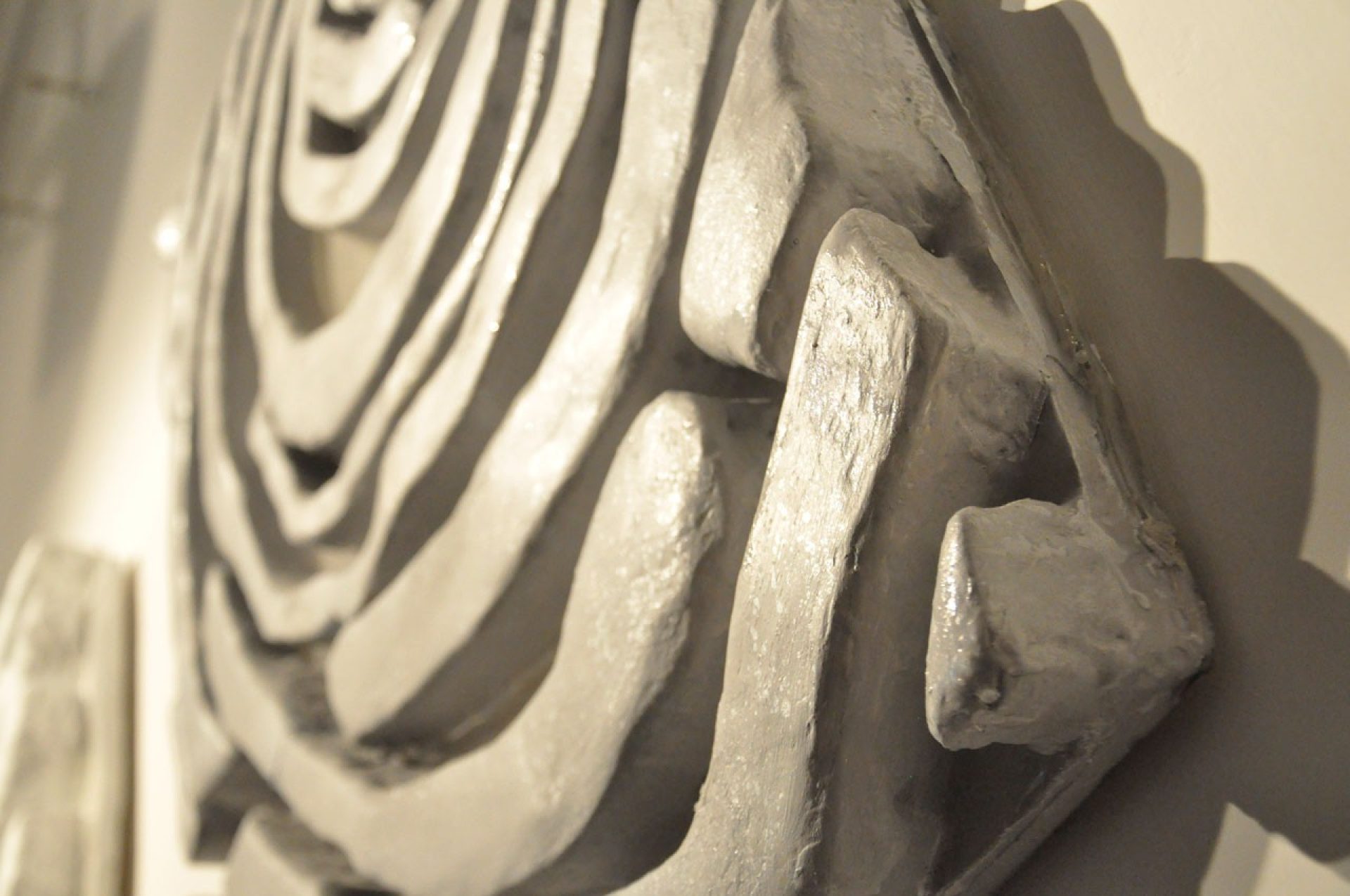
And they truly are journeys, because visually this transcription of fingerprints into a three-dimensional image evokes the idea of a labyrinthine path, seen from above, since the images are in relief, with a perception similar to that experienced when walking through Burri’s Cretto in Gibellina, which does not resemble these paths but is organized similarly. Legnaioli creates forms that are all similar and all different, and the labyrinth-like image becomes strongly imprinted in the observer’s mind, conditioning it.
And what is it conditioned with, as a kind of compulsion to repeat the image itself? With the sensation of facing infinite combinatory possibilities, just as happens with numbers. What becomes apparent is that the framework, one might call it, of the various images is a mix of the microscopic and the gigantic, as if we were looking at fossil remains of a remote and petrified world. Instead, it is simply the magnification of the quintessential living form, the fingerprint, which can only be truly seen through enormous enlargement.
Thus, it is a sort of microscopic operation in which the idea of the Portrait approaches abstraction, and the discovery of a common essence allows for an intuitive understanding of how the differences between one individual and another are in fact minimal yet equally determining.
It is as if the artist wished to show us the representation of the concept of probability calculus, which is immense and recurrent, as is well known.
Thus we may try, becoming tiny thinkers, to enter those microscopic spaces with the simple yet fundamental aim of knowing ourselves better.
Claudio Strinati
The works created by Micaela Legnaioli strike us at our core. The research in this strong and intense body of work focuses on a continuous inner investigation and on a model — “humankind and its identity” — already observed in previous works, now showing clear evolution.
The exhibition Impronte originates from a study of the human species begun some time ago by the artist, moving between art, science, psychology, and sociology, with a strongly symbolic value: the image of us as beings who are unique in our diversity, later transformed with natural abstraction into matter.
The work of Micaela Legnaioli undoubtedly invites reflection, for one cannot remain indifferent: a personalized fingerprint, reproduced with mixed media and developed naturally, leads us — once created — to face not only a sculpture but also to imagine real people, with genuine feelings and personalities, albeit represented symbolically and abstractly.
Through careful observation, one can discover in the seven works on display — each of a different size based on the scale of a human being — wall sculptures with three-dimensional shapes and strong personality, created through a specific study linked to the use of materials and consciously elaborated. Works with undefined edges, carved into the material to create grooves, as in life, which are shaped and accentuated, forming delicate shadows. A special light emerges through acrylic colour combined with resin, dominating the scene and creating volume.
In her artistic and expressive research, composed of slight shifts of plaster material on wood, the artist intends to make us perceive a boundary line between the Self and the Being — between the Artist and the Human — between Us and Individualism.
These works break down intercultural, racial, and religious inequalities. They allow a timeless soul to resurface, the immutability of an individual’s identity reflecting personal experience: for the artist, it is like speaking of us, in her search for truth. An abstract approach that nevertheless conveys the deepest feelings of the human psyche.
The exhibition, hosted inside the Menexa space, is a project presented for the first time to the Roman public, in which the artist seeks to create a cultural synergy among various realities to promote culture at all levels. The theme of Impronte and rediscovering our identity is more relevant than ever today. What better occasion, through this exhibition, to introduce the artist and her contemporary artistic technique?
Sveva Manfredi Zavaglia
Gallery


