Artists
Curators
Distinctions remain valid for better understanding in art. According to this approach (with many notable examples, like Contini who completely distinguished Dante from Petrarch, or Worringer who dissected abstraction and empathy in art), there are linear or multiverse artists. Simone Bertugno belongs irrevocably to the latter type. Facing his works requires openness to wonder, a grand and untamable proliferation, an excess that, to be most effective, draws on models from a curious and voracious antiquity.
The images of Venus are extremely varied in antiquity. From Cypris to Callipygia, all versions combined sex with beauty, celebrating joyful multiplication and expansion. Venus, in Lucretius’ words, “is the only element that, the more you possess,/ the more the chest burns with infinite desire”: the poet’s words testify to a pleasure only much later restrained, as ardor, linked to the body, and boldness, related to knowledge, share the same origin.
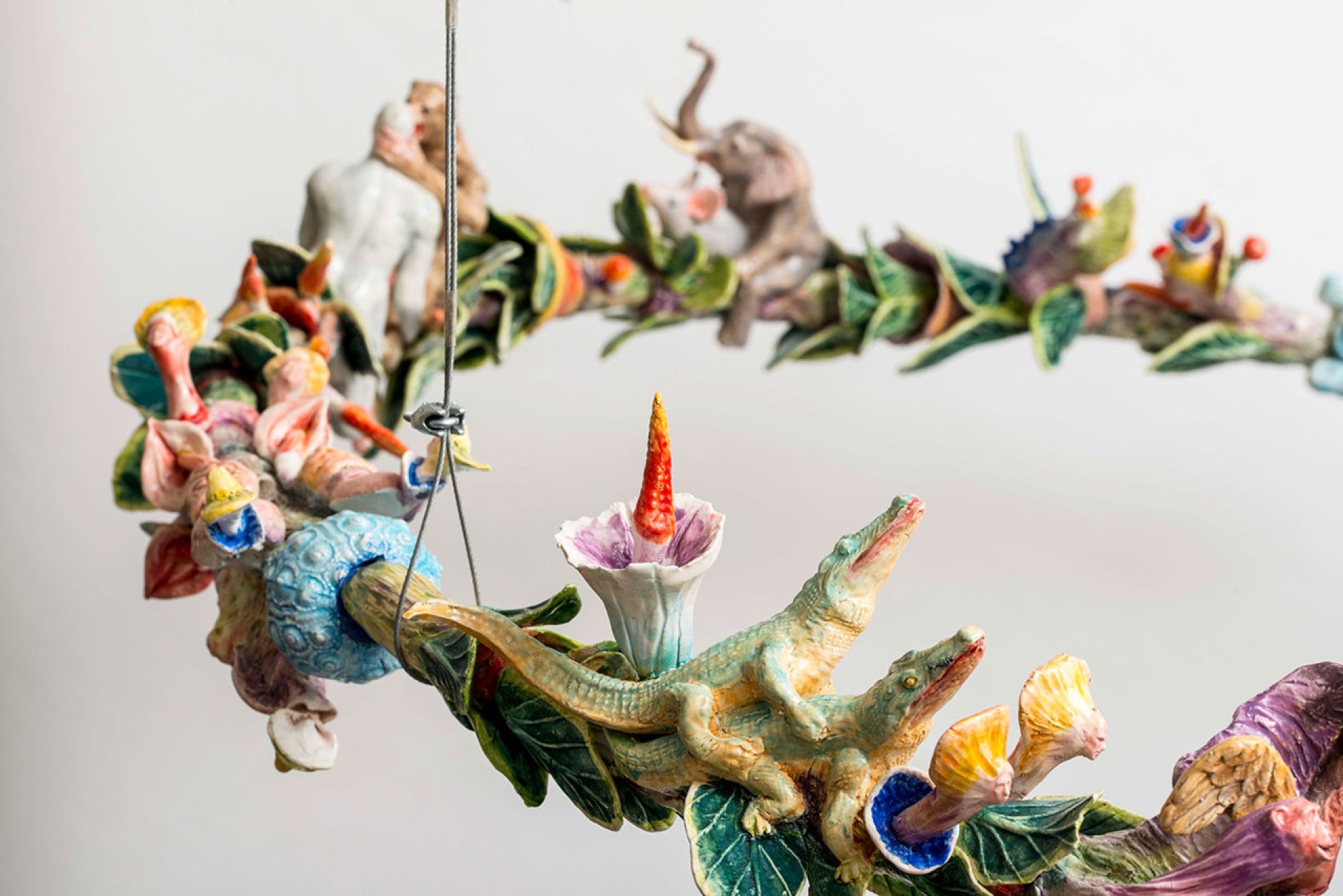
This latest work by Simone Bertugno marks a transition: from regulated and sequential proliferation to an expansion of desiring fields (as Deleuze and Guattari would say); this is the deep eroticism of this research, which through the combination of bodies seeks the laws of attraction among elements. In previous works, one could witness orderly and sequential germination; now, there is uncontrolled proliferation. Associations occur on planes guided more by whim and possibility than by natural laws. In its evolutionary process, with amphibians, it has covered the interval between land animals and fish, and with various species, it spans from terrestrial to flying creatures, and then from animal to plant to mineral. There is crossing, mixing, and corruption, such that the law of intersection and encounter seems supreme, like survival itself. It is as if nature experiments with itself, generating new creatures through unprecedented encounters.
The creatures travel erotically. From the Rape of the Sabine Women to the Oedipus complex, it has long been known that survival depends on dialogue between different worlds, since one can only love what is different, and the more distant it is sought, the greater the knowledge and enjoyment. Art cannot escape this law. As Henry Miller said: “Human creatures form a strange fauna, a strange flora. From afar they seem negligible, up close they may appear ugly and bad. But above all, they need air around them, sufficient space—space, even more than time.” In the words of the writer, fauna and flora, space and time, intermingle. In this exhibition, the transition is from plausible productivity to a Leibnizian space, from the line to the circle, with a multiplication of possibilities that surprises as it generates. Experimentation for Simone Bertugno remains erotic, spanning the space between curiosum (rare phenomena, wonders) and love for the infinite branching of imagination, which naturally and regularly becomes knowledge: there is no greater attraction than that uniting desire and wisdom.
Paolo Aita
