Artists

Curators

“Only loving, only knowing
matters, not having loved,
not having known. It is anguish
to live on a love consumed.
The soul no longer grows.
Here, in the enchanted warmth
of the night, full down here
between the river’s curves and the dormant
visions of the city scattered with lights,
still a splinter of a thousand lives,
disaffection, mystery, and misery
of the senses, make hostile to me
the forms of the world that until yesterday
were my reason to exist.
Bored, weary, I go home, through black
market squares, sad
streets around the river port,
amid shacks and warehouses mixed
with the last meadows.”
(Pasolini, The Weeping Excavator)
Photography has immediately established itself as a generator of a shared symbolic dictionary for the sake of communication and remembrance. Over the decades, it has marked the reduction of the entirety of human experience to a single sense—sight.
Today, however, the spontaneous practice of millions of photographers worldwide has become a mere habit. Taking a picture is no longer the result of observing but of simply seeing—an act of mechanical appropriation that has nothing to do with artistic practice or information. The photographic man has surrendered to the consumerism of images and returned to Roland Barthes’s notion that the photographer’s true organ is not the eye but the finger—the act tied to pressing the shutter. In her essay On Photography, Susan Sontag writes: “Photographers were asked not to limit themselves to seeing the world as it is, including its already acknowledged wonders: their task was to arouse interest through new visual decisions.” Similarly, Alfred Stieglitz proudly recounts waiting three hours in the snowstorm of February 22, 1893, “for the right moment” to take his famous photograph Winter on 5th Avenue. The right moment is when one can see things—especially those everyone has already seen—in a different way. “One must find beauty through another way of seeing”: this was the only way to generate beauty worthy of attention in Sontag’s and Stieglitz’s time. Yet, as we said, things have dramatically changed today. Photography can no longer admire things from a different angle because every possible angle has already been occupied by an image. The diffusion of lenses across the world has made a sort of omniscience possible—a chaos of vision that transforms the photographic medium into an eternal, timeless entity, without boundaries or limits. Nothing seems able to capture the common feeling anymore. To break away from canonical standards and restore focus on the image, one must attempt to make new visual decisions.
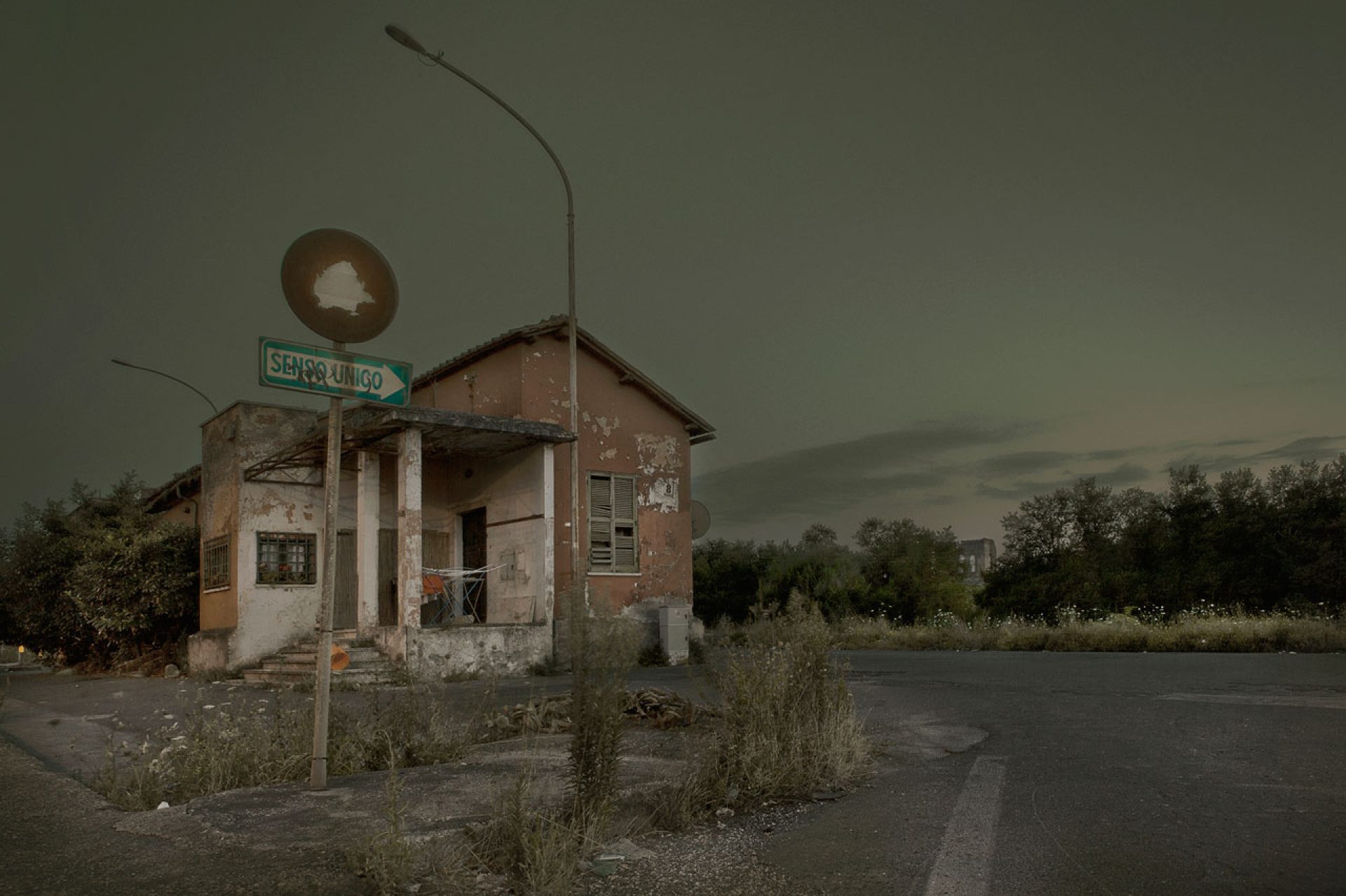
Angelo Marinelli’s photographic research seeks to rediscover a new identity of vision through choices that, in fact, plunge into the light itself, reorganizing even the portions of time that determine the formation of the image. His monolithic and silent panoramas of modern society represent a new way of managing the metaphors of vision without falling into clichés or useless baroque excesses. In the poetics of abandonment and the search for emptiness as the perfect point of ascetic reflection, the artist brings to light a universe made of minimal movements and dense architectural stratifications. Such qualities contribute to building a perfect and delicate mythopoiesis resting on time itself as the generator of images. Angelo Marinelli’s gaze is able to rediscover beauty through another way of seeing reality, reigniting the taste for the enigma hidden behind everyday things. His research carries something Homeric, to which a fair amount of melancholy is added—transforming each photograph into a metaphysical space frozen in memory. Indeed, it is memory itself that self-generates in the viewer’s mind, who absorbs the vision and makes it their own. The choice of colors and tones, often cold and desaturated, achieves a soft and sensual structural setting and linguistic technique that heighten curiosity and fascination in every frame. The images thus become a private form of dialogue between the formation of all things and the retina observing them from every possible angle—an omniscience dictated by the camera lens, which rediscovers the pleasure of deciding and astonishing through beauty and a new way of seeing.
Micol Di Veroli
It is as if, gradually, everything in this city is changing. Despite Rome’s ability to surprise and move, there is now a shared disillusionment—with modern society, with the allure of the big city, with the metropolis, and consequently, with the Eternal City itself.
The Rome that once had the power to surprise and help overcome the “enough, I’m leaving” moments—the times when one questioned the reasons for living in such a large city made lately only of flaws, with its virtues belonging only to history—has been changing in recent years. As if abandoned to itself, it is now revealing the image of a city once again full of contradictions, partly urban, partly rural.
The images I chose to imprint in the series “Almost Elsewhere” depict a city that suddenly finds itself almost uninhabited, abandoned to itself and to the few who remain. A city that, no longer having a reason to exist as a metropolis, begins to undergo a process of transformation through abandonment—almost as a response to the need of those who leave to return to a life made of simple, natural things, to a rural existence.
“Almost Elsewhere” aims to document a future Rome, deserted, where monuments and architecture once again become stone, concrete, and dust—devoid of any historical or stylistic value.
Angelo Marinelli
