Artists

Exploring the meaning of resistance in contemporary society requires looking beyond the immediacy of acts of opposition. Persistence seems to be another key, a fundamental element of the social game in which participants act, expressing this natural inclination preceding claims.
Resistance, seen as perseverance in action and intent, aligns with the survival instinct that rejects surrender and anticipates struggle.
In this sense, the work “It’s just a game” by María Rosa Jijón—from the eponymous series—highlights two opposing forms of resistance: the first marked by persistence and inevitability, the second by the nature of opposition.
Like an endless carousel, continuous migratory flows and attempts to block them by the traversed countries chase each other. Like “equally resistant” magnetic signs, they repel each other in a skirmish stripped of human aspects, reducing it tragically to a large role-playing game. The artist blends playful and real elements, orchestrating a ballet of double meanings set to the Super Mario Bros soundtrack—a video game and music used as torture—played during the opening instead of the usual lounge tracks.
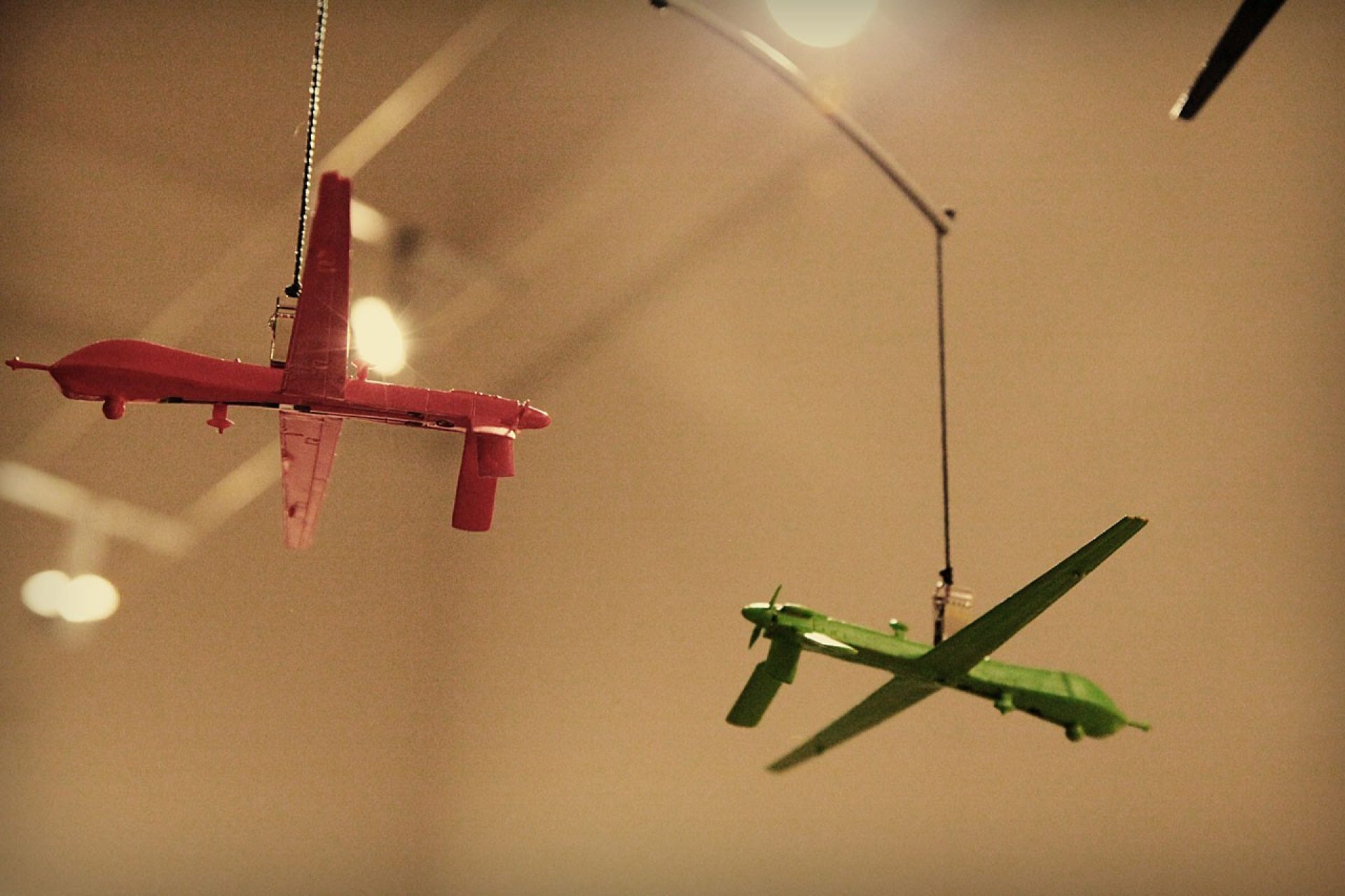
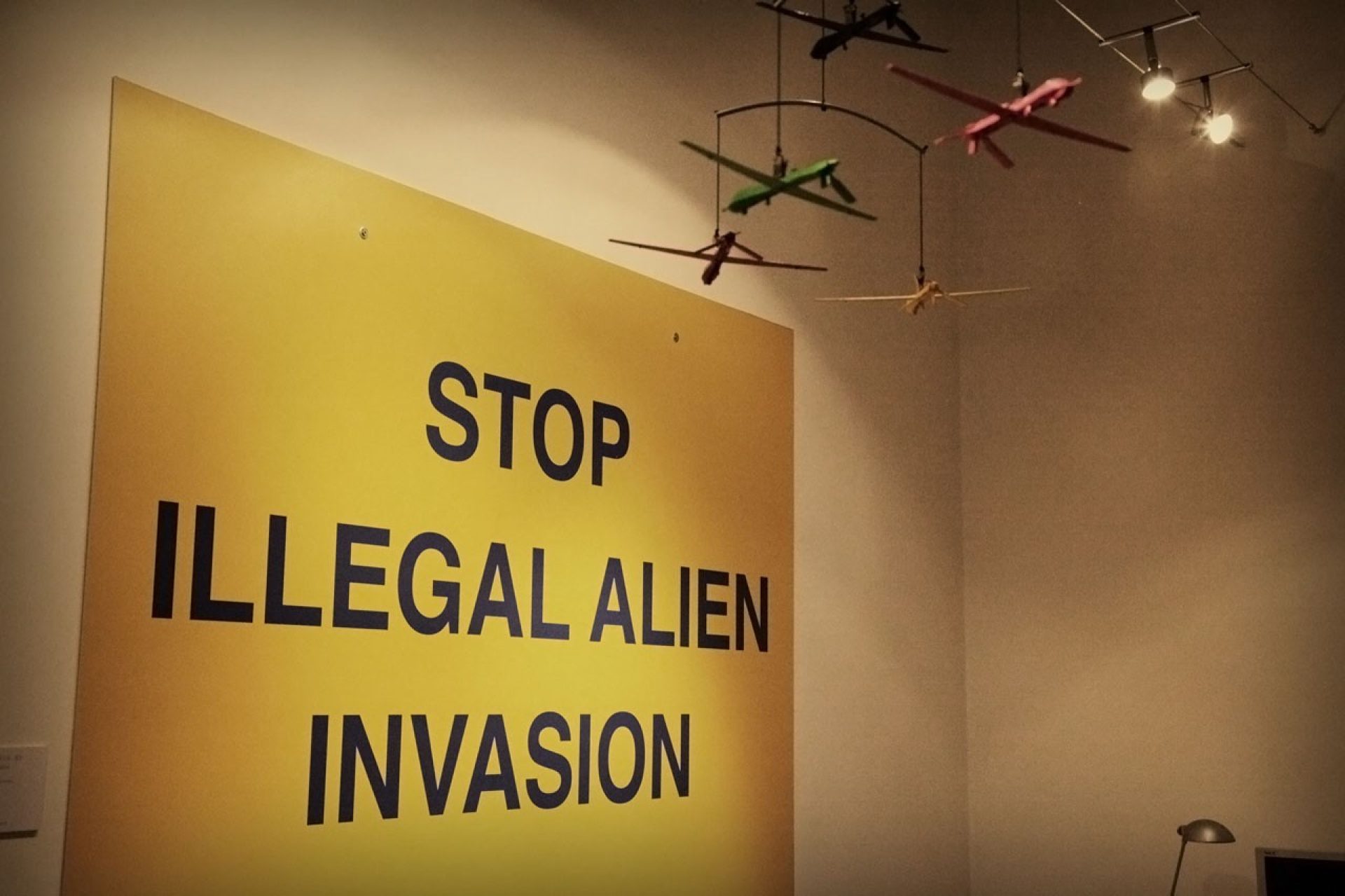
Although the installation does not show migrants directly, the work narrates their persistence through the contrasting action of the opposing side, emphasizing that it exists only as a counterbalance. This triggers the macabre game: drones—used to monitor migratory movements along borders—become a mobile carousel, hovering over those who cannot sleep, projected onto a frontier yet to be constructed (during the inaugural performance), contrasted with its ideal dismantling through continuous crossings. On the wall, the sign “Stop Illegal Alien Invasion” plays with English words: referring to undocumented migrants while winking at an alien invasion from a superficial translation.
It is all just a game, a representation drawing on memories of toy soldiers, water guns, war video games, and bullying. María Rosa Jijón’s intervention raises the issue of cruelty: the innate malice manifesting from childhood, superficiality, mockery, aggression—a negative force requiring its own form of resistance. Resistance to the cruelty of the world, as Edgar Morin notes (I miei demoni, Meltemi Editore, Rome 1999), underlies all acts of resistance, even political ones.
Gallery