Curated by Giovanna Sarno
Leda Patasheva presents a series of works that describe the blossoming of encounters between human beings, religions, and different languages. Inspired by the long tradition of the Eternal City, the artist feels welcomed by Rome, which makes her feel at home, and she conveys this impression.
She has always sought to photograph symbolic, unique moments of life that represent a specific culture. Now enriched by continuous encounters with diverse worlds, she has developed a refined and sensitive eye capable of capturing common elements within diversity.
Gestures, postures, and gazes that, through their intensity and eloquence, unite human beings from all latitudes. Elements that make communication possible.
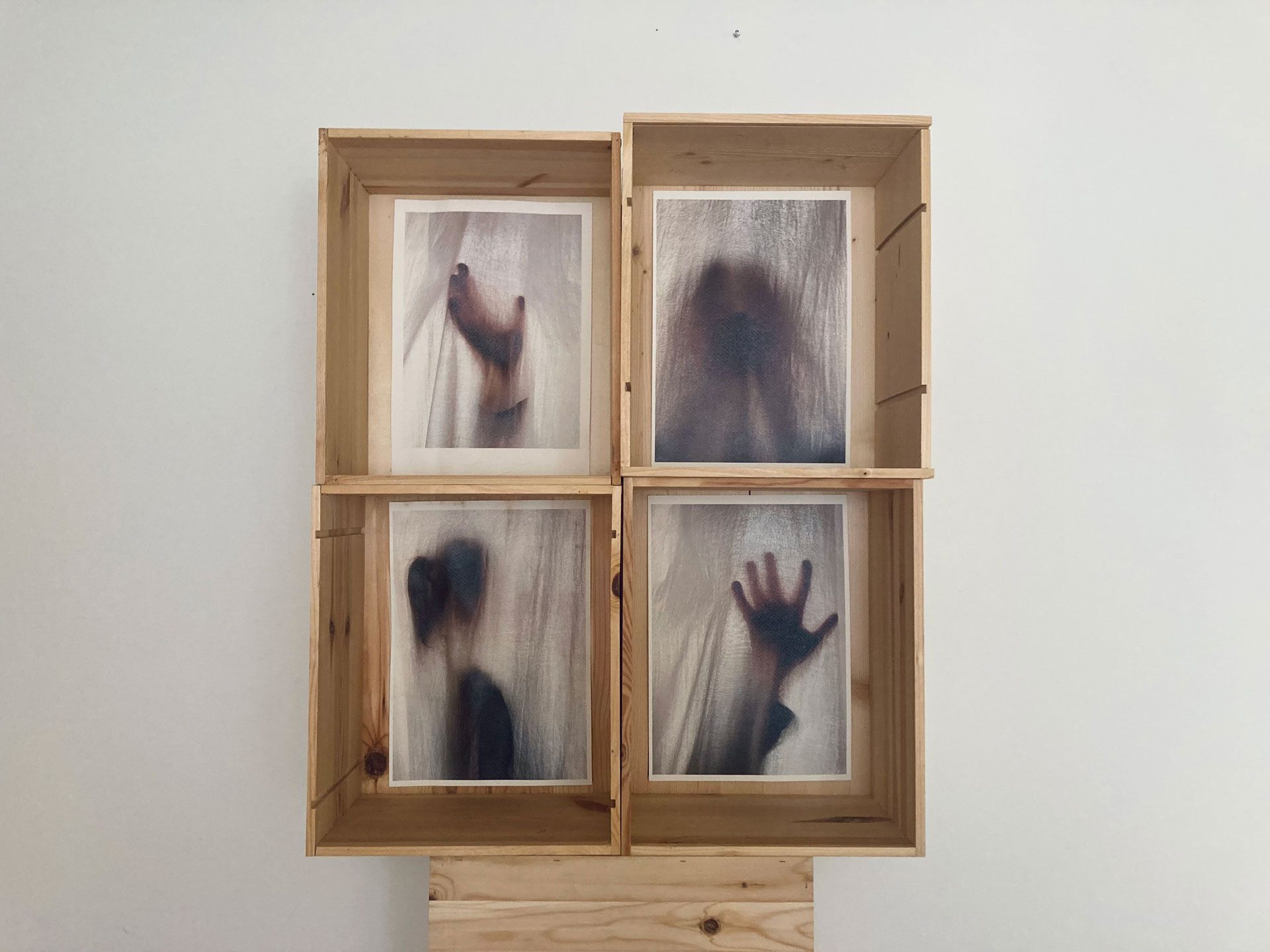
In these photographs, the artist captures a moving gesture that reaches toward the viewer.
The request is then set within a wooden case, a traditional fine wine box, conveying a message that moves in opposite yet adjacent directions — a gesture protected by the wood but also constrained, ready to return to darkness as soon as the gaze turns away.
Indeed, the image remains indistinct and unknown, emerging from nothingness and the unknown. It is this dematerialization into a monochromatic hue, an unfinished thought, a merely imagined desire that grants the sparkle of universal art — speaking without the need for explanation.
What remains is the shadow of an intention whose end we do not know.
The artist captures something in its nascent stage — a prelude to an encounter — and places this delicacy in place of fine wine, itself a metaphor for connection, movement toward others, and conviviality.
Wine, as an evoker and messenger of ancient traditions, is laden with meetings and exchanges.
The poor, untreated, and unrefined wood of the boxes recalls the great Italian art of the 1960s, when Germano Celant coined the term “Arte Povera,” describing an art rich and fertile in concepts, all expressed through simple, easily accessible materials — with the hope of focusing the viewer’s attention on meaning and message rather than on materials easily monetized.
The works can only be viewed frontally, from an attentive and private position, offering a defined space for contemplation. This is the artist’s final advice for encounter — one must give their time, responding to intention through an act of rupture, tearing the veil that divides and separates, like indifference.
To overcome indifference — a gesture requested of the viewer — who is called and engaged by it.
By the artist’s will, the proceeds will be donated to the charitable works of Circolo S. Pietro.
Born in Sofia in 1974, she chose encounter and travel early on, attending a Russian diplomatic high school in Sofia, later studying French literature at the University of Geneva, and specializing in translation — mastering five languages — at the United Nations. Without ever distancing herself from her expressive medium, photography, she participated in a masterclass in 2005 with Nikolay Treyman.
Gallery


