Artists

“In the beginning God created the heavens and the earth. The earth was formless and desolate, and darkness covered the abyss, and the Spirit of God hovered over the waters.”
This is how the first two verses of the Book of Genesis begin, the opening of both the Bible and the Torah, from which Paul Alex Samaniego drew inspiration for this unpublished project presented at Spazio Menexa.
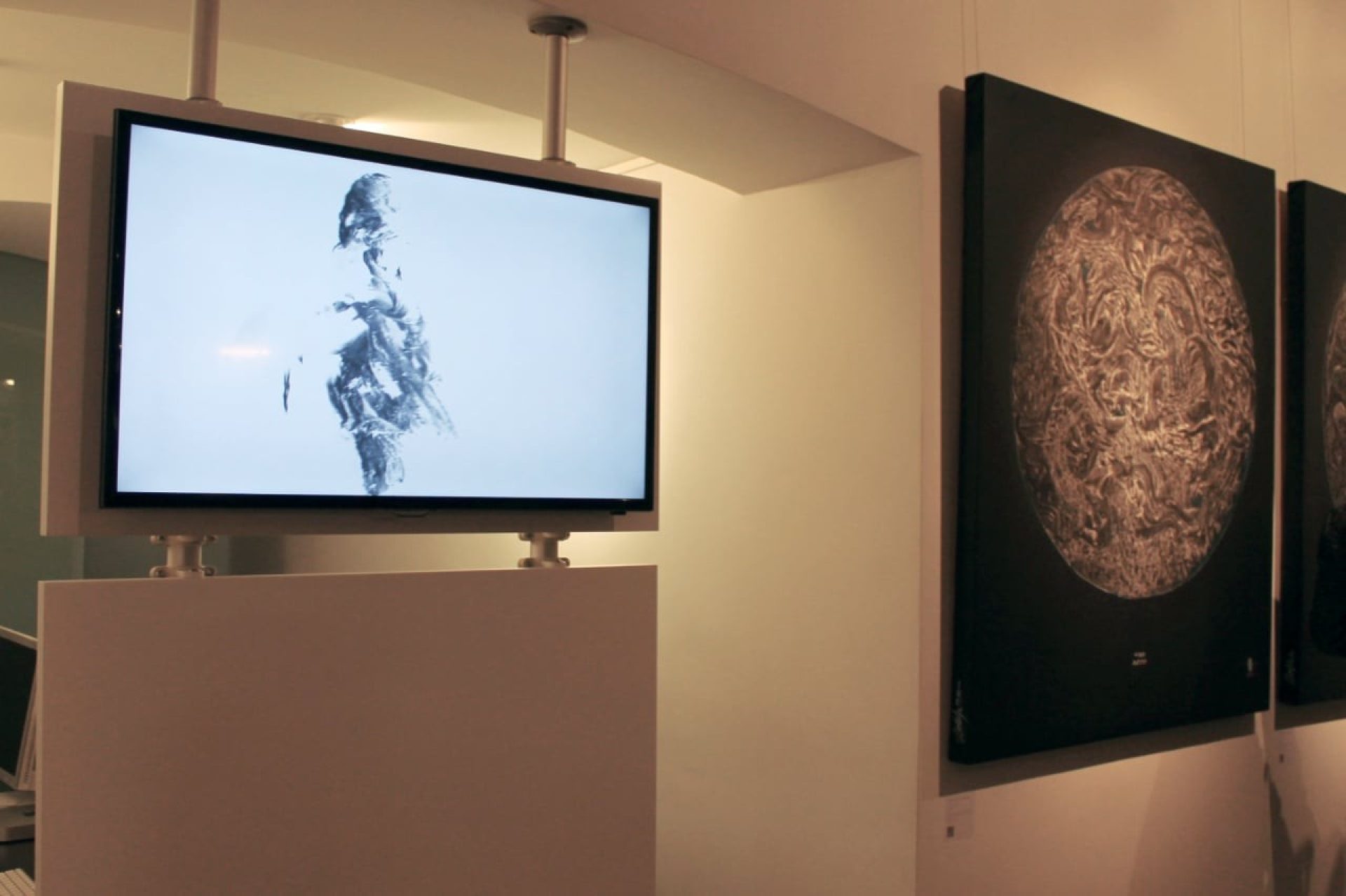
Origo, a title that already contains the key to his research, is an exhibition composed of four large canvases and a video reflecting the relationship between the primordial chaos and that of today, in a parallel of continuous mediation between the artist’s own turmoil and that of the world we inhabit, prompting the natural question of whether Paul Alex Samaniego is speaking of the beginning or the end of the world.
This is one of the questions raised when observing the artist’s canvases, where chaos and stillness coexist. Here the artist retraces the creation of the world at the origin of perfection and incorporates the entire complexity of evolution within the circle of life.
Striking, in fact, is the arrangement of the strokes within what may appear to be a cellular element inspired by the evolution of the zygote which, through blastocystogenesis, generates totipotent blastomeres. With this, the artist perhaps intends to highlight the infinite potential of the individual, often forgotten or diverted toward self-destruction.
The centrality of the paintings, which at first glance evoke an ancient shield, contains within itself all the strength that in its circularity—steeped in apparent chaos—remains cohesive, defending itself from the darkness surrounding it. At the edges, the energy expressed by color struggles to protect this idea of identity, while at the same time uncontrolled and unaware energy opens fissures within the disc, undermining its very integrity.
The power of these works is heightened by the use of particularly significant materials such as charcoal, ash, earth, tempera, Arabic glue, and acrylic enamel, juxtaposed on an eco-leather support and marked by the work’s title written in Braille, as if to suggest that a complete reading may only be achieved with a deeper level of awareness.
Day VII — Humanity
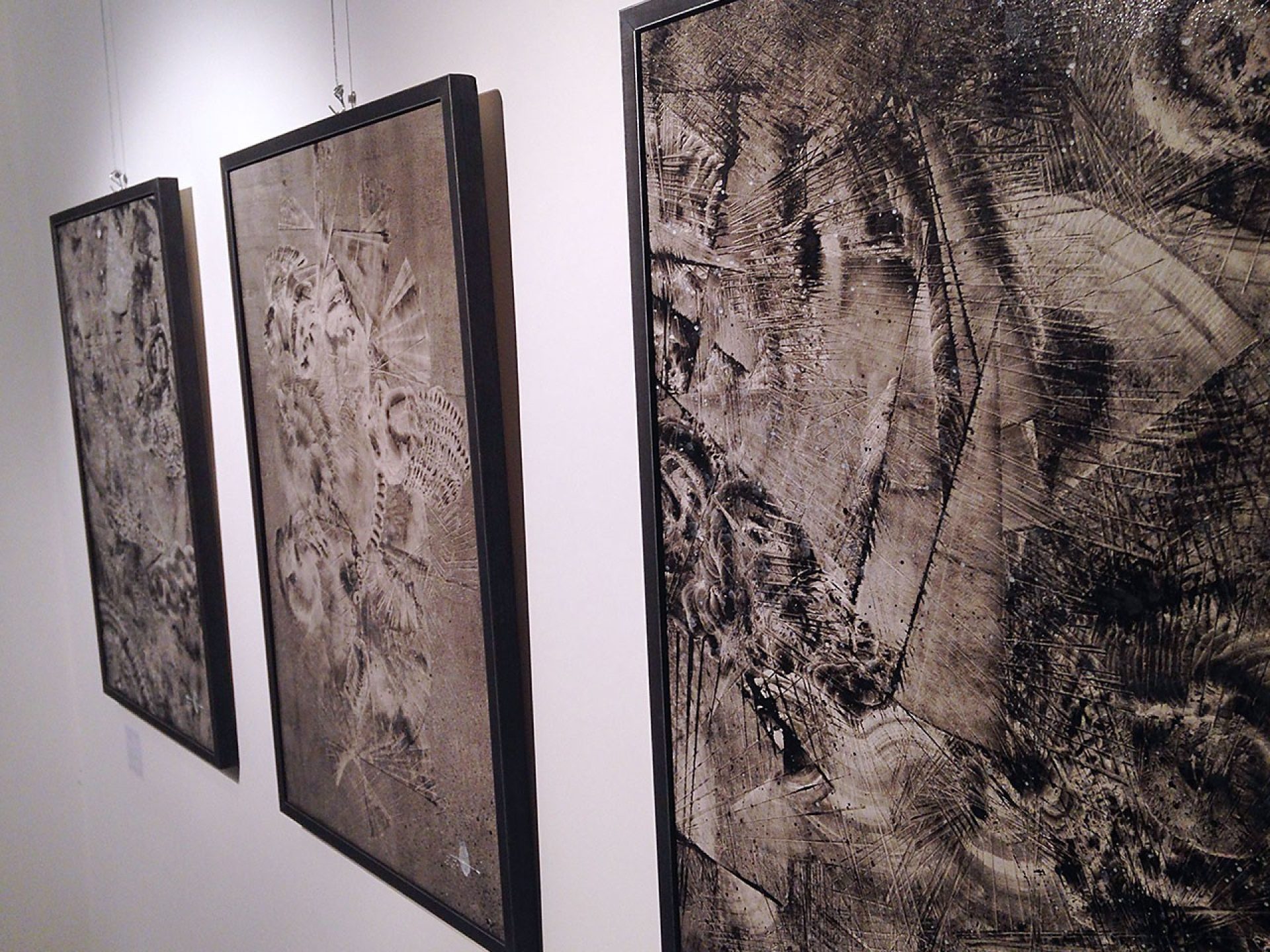
Paul Alex Samaniego opens a door to reflection on the creation of the world and that of humankind, a question that troubles sensitive minds in search of reasons behind things. All religions have sought to construct narratives about the origins of the cosmos and the human species; the Christian tradition dedicates the Book of Genesis to this explanation, describing humanity as the essence of creation, dominator of all things, and emphasizing how everything was made out of love for humankind. The contemporary world offers its own assessment by formulating hypotheses on the origin of the cosmos, and Paul A. Samaniego lays out a visual path made of complex and intricate strokes reaching the creation of humanity, then questioning what comes next.
What happens after the completion of the sublime act of creation? Afterwards, humanity advances in conquest, and the evolution of its existence becomes a tale of escalation and intensification. By leaping forward to our own time, the artist denounces the decay that marks human actions and offers an analysis of the contemporary scenario in which we live, revealing some of the modern world's problems by examining the economy as a dominant force. He highlights the law of supply and demand, central to economic issues, the problem of public housing echoing ancient concerns over the hearth, and television as a one-way communication tool often used to manipulate the masses.
The transition from the tale of creation to that of the contemporary world occurs through humanity. Formally, the artist shifts from circular, spherical marks to intersecting, overlapping, or diverging straight lines—lines that signify evolution, echoing the familiar visual language of the Russian Rayonists, who synthesized Cubism, Futurism, and Orphism, creating spatial forms born from the intersection of rays reflected from various objects. All of this is expressed through a technique reminiscent of prehistoric cave paintings, which early humans used as a means to narrate their simple lives and surrounding animals. The artist reinterprets this technique using charcoal, ash, earth, Arabic glue, and acrylic enamel on eco-leather—a material of today—to narrate the complexity of what humanity has become, along with modern life's habits and problems.
Conceptually, the analysis of the present world is portrayed as that of a fast and superficial age, one that does not pause to ask the right questions—questions tied to the fundamental values and rights that all people should possess in order to live a life worthy of the name.
Micaela Legnaioli
Gallery