Artists

Curators

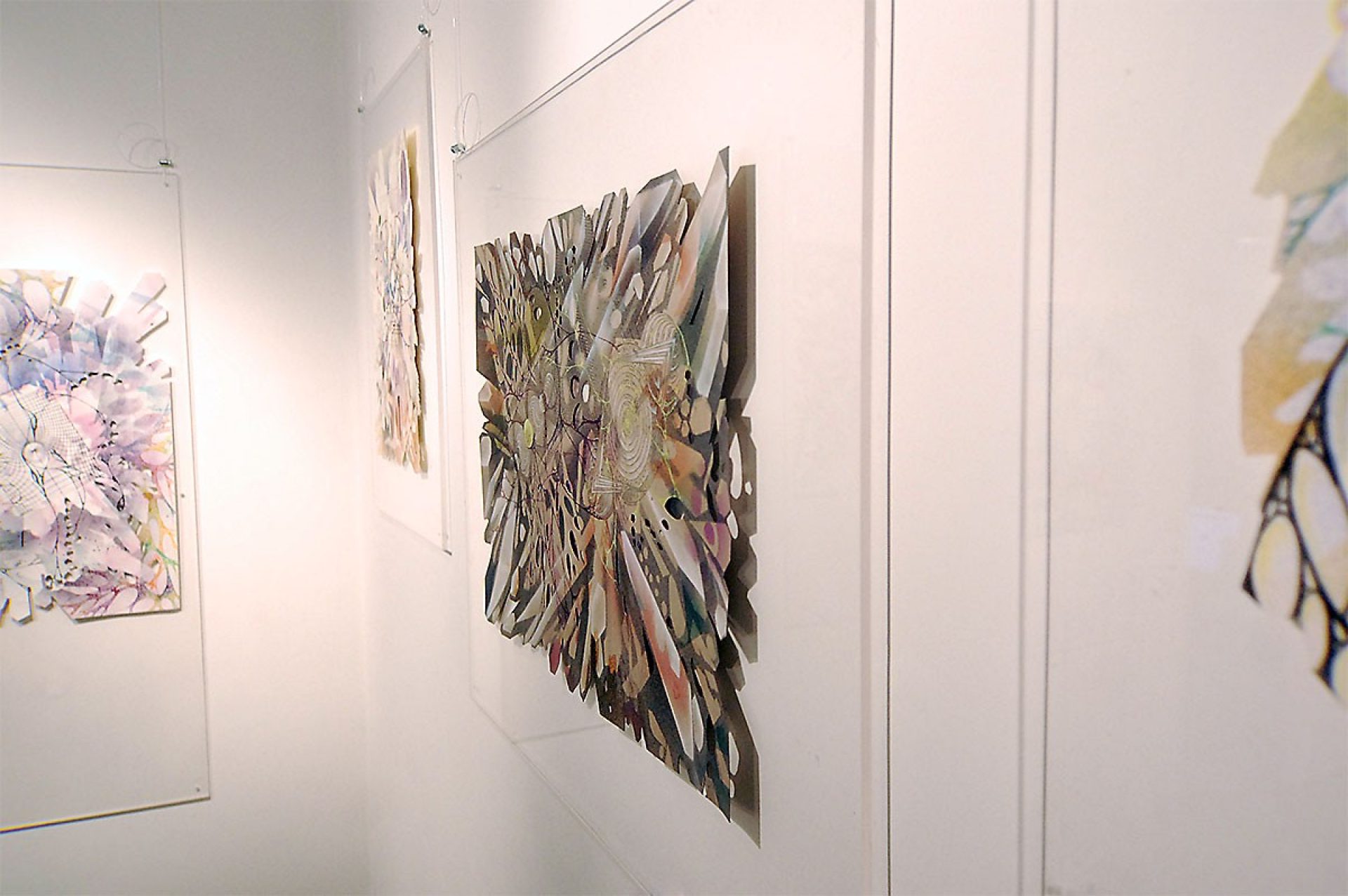
The exhibition Electric Utopias introduces a new way of working with the printing of legendary documents. Historical scientific treatises and demonstrations—once proven or abandoned—are reinterpreted by the artists, starting with paper cutting, followed by printing with antique presses and watercolor coloring. We enter a vivid, colorful world portraying the fluid and complex environment of the theory of everything, moving through string theory that shapes matter and describes radiation, space, and time. Drifting through this chromatic universe becomes a journey into theoretical physics, guided by fundamental physical entities and the poetic imagination of Giulia and Karolina Lusikova.
Electric utopias: the pairing of words, to the ear, sounds like something taken from a notebook of Filippo Tommaso Marinetti. It is not. The ear sometimes deceives. And the eye? Let’s try to direct it toward one of the “scientific” watercolors by Giulia and Karolina Lusikova: a diagram of elegant lines, on which mathematical equation symbols rest, stands at the center of a jagged nebula of colors, from cosmic blue to deep violet—one might be tempted to say ultraviolet, were it not imperceptible to the human eye. Everything is captured in a slow explosion; a kaleidoscopic fragmentation. Perhaps caused by a supernova.
The lines, with curves reminiscent of a fantastic aviary, graphically represent one of Maxwell’s equations on electromagnetism. In physics, these equations are considered a masterpiece of synthesis. They explain electricity and magnetism in a unified formula. They inspired Hertz, Righi, Marconi, and Einstein. They marked the first step toward understanding the nature of light. And they opened a new conception of space. Here the connection between science and art becomes tighter. More compelling.
Maxwell’s equations date to 1865, though their influence extends through quantum mechanics and into the third millennium. In the artwork on paper, the two authors, mother and daughter, have cut out empty spaces, segmented contours, traced lymphatic veins, colored tendons resembling certain depictions of hyperspace seen in science-fiction films. It is a strange world. Their compositions evoke crystals containing worlds—and suggesting others. We are light-years away from the futurists’ progressive faith in science. It is true that the equations predate Marinetti & Co.’s manifesto and that in the early 1900s they sent concentric ripples through scientific research and technological applications. In other works, the graphs and diagrams placed as impermanent gravity centers within their compositions are even older—ancient, as in an acrobatic curl by Albrecht Dürer, a measurement around which color gathers. But again the point lies in perception. Since the publication of the futurist manifesto—filled with passion for electricity, utopias, and dystopias—more than a century has passed. In these 107 years there is much: Einstein’s general theory of relativity, Heisenberg’s uncertainty principle, the American flag on the Moon, the floating monolith in Stanley Kubrick’s celluloid. Black holes, subatomic worlds where anything seems possible, space telescopes. The B-beams glittering in the dark near the Tannhäuser Gate seen by a replicant, to quote another sci-fi masterpiece. Gravitational waves, newly discovered. Electricity has become—or returned to being—mysterious. And the adventure of art in space is a leap into the unknown.
These are not merely external, cosmic spaces. In the watercolors painted four-handedly by mother and daughter—and extensively discussed during execution—there are interior spaces as well. Again sparked by scientific suggestions. Thus we find another diagram, immersed in green and violet—a lymphatic green, a violet from a forest fairy’s makeup case. This time it does not address physical laws but seeks to draw the unconscious. The attempt is real and dates to the late 1800s. It was undertaken by a New Zealand psychologist, Benjamin Betts, who experimented with the extravagant challenge of giving an exact mathematical form to the stream of consciousness of the human psyche. The result recalls stylized flowers and plants; one of them evokes a large trumpet-shaped installation by Indian artist Anish Kapoor permanently displayed at MAXXI in Rome. A utopian exercise, without doubt—like the attempts of magicians, Renaissance artists, alchemists, and theoretical physicists to formulate a representation of the whole. A flawless world. The perfect human. Utopias often fail in the real world, true. After all, the term means “in no place.” An immobile, ideal world one may strive toward—almost touching it. Electricity, instead, is movement by definition. Energy. Karolina and Giulia are artists inspired by utopia, perhaps even more than by science—or better, by the tension toward utopia, by the energy utopia sets in motion. This is why I enclosed the adjective “scientific” in quotation marks earlier. Their science is dense with mysteries, with moving particles. As science should be for artists. Not surprisingly, among the diagrams inserted into their crystal-paper artworks is one traced by a 19th-century mage, Eliphas Lévi, born Alphonse Louis Constant. It is among the most evocative, reminiscent of the astrological drawings in alchemical and astrological manuscripts of the Renaissance. This time the colors are compact, like a treasure chest. They evoke the passage of time. Time that changes perspective.
If in Marinetti’s pen the electric utopia could sound like a provocative slogan, the Lusikovas’ works displayed at the Menexa space carry the thrill of an oxymoron: opposing meanings releasing illuminations—or at least sparks. Much like electricity itself. And to close with a nod to another contemporary space—the digital one—no Google search for Marinetti and electric utopia returned any results.
Fabio Sindici
Gallery


