Works on display
Artists
Curators
360
CURATED BY LUDOVICA PALMIERI AND MASSIMO SCARINGELLA
Overcoming the Void to Return to the Human and Write a Different Future
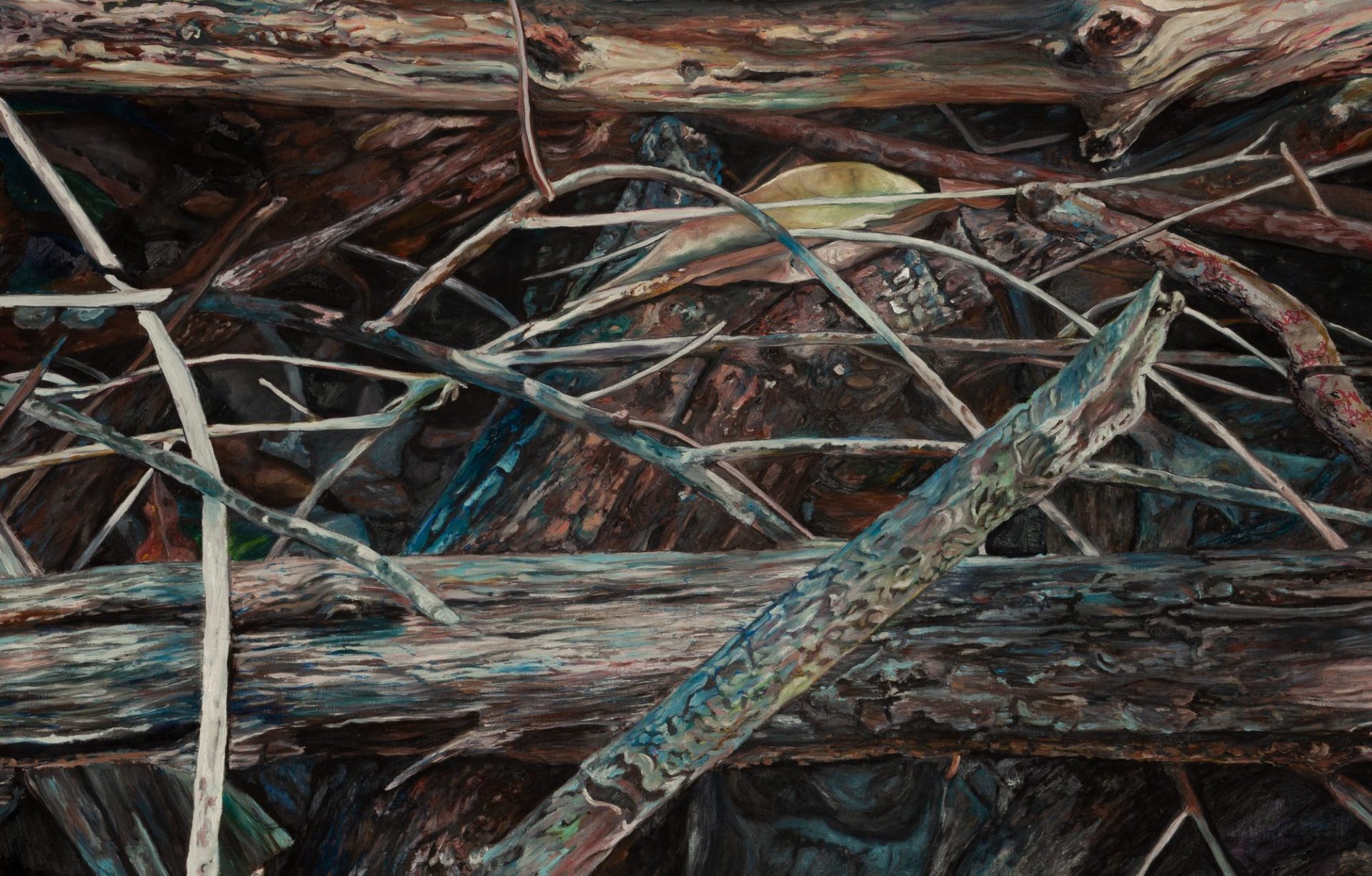
Seven works. Large, heavy, physical. Born from the artist’s direct engagement with the canvases. Painful works, arising from the observation of reality, from a “true story” indeed. Yet in their being, they open onto another, parallel dimension. Far from the concreteness and conventions of the real.
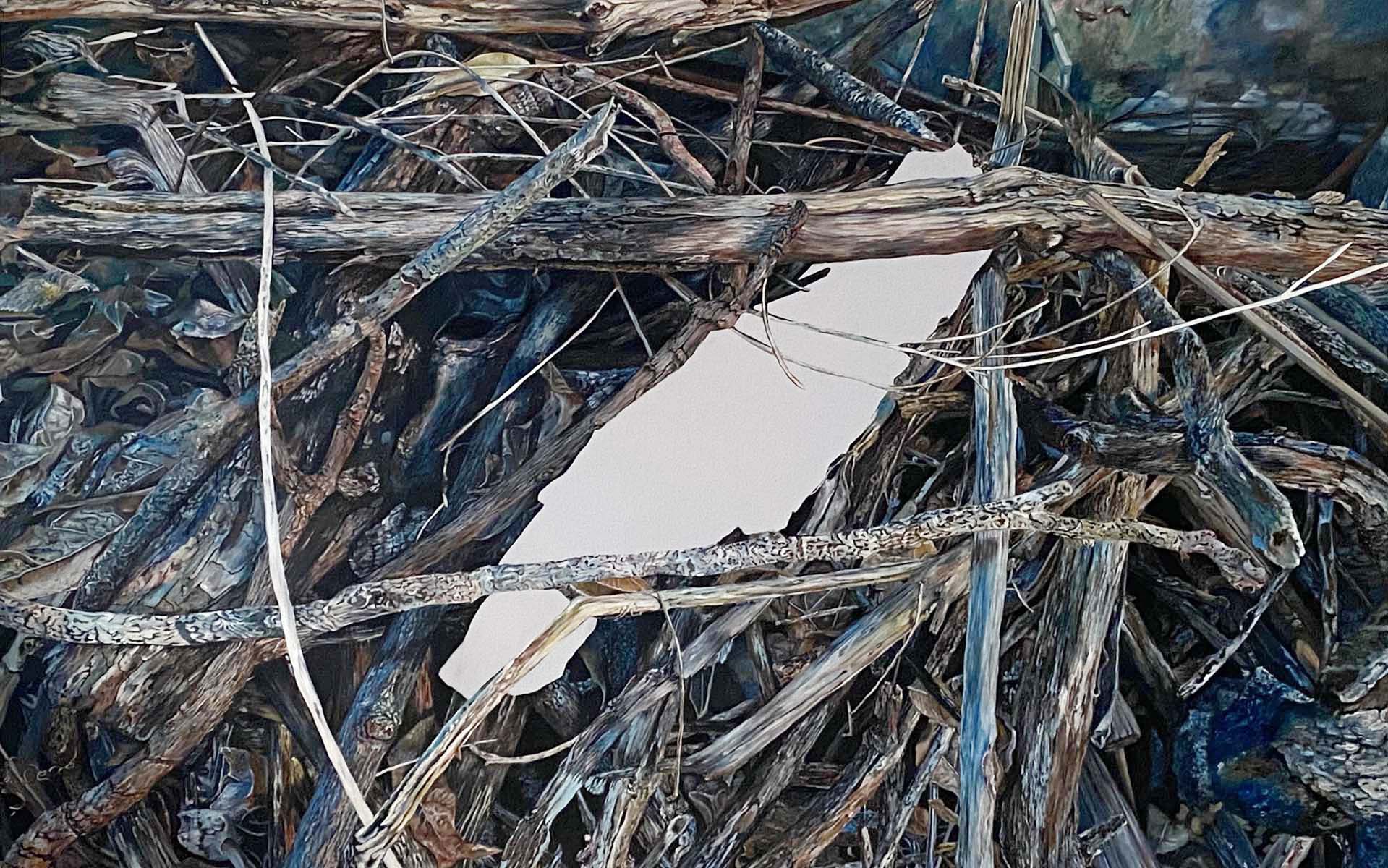
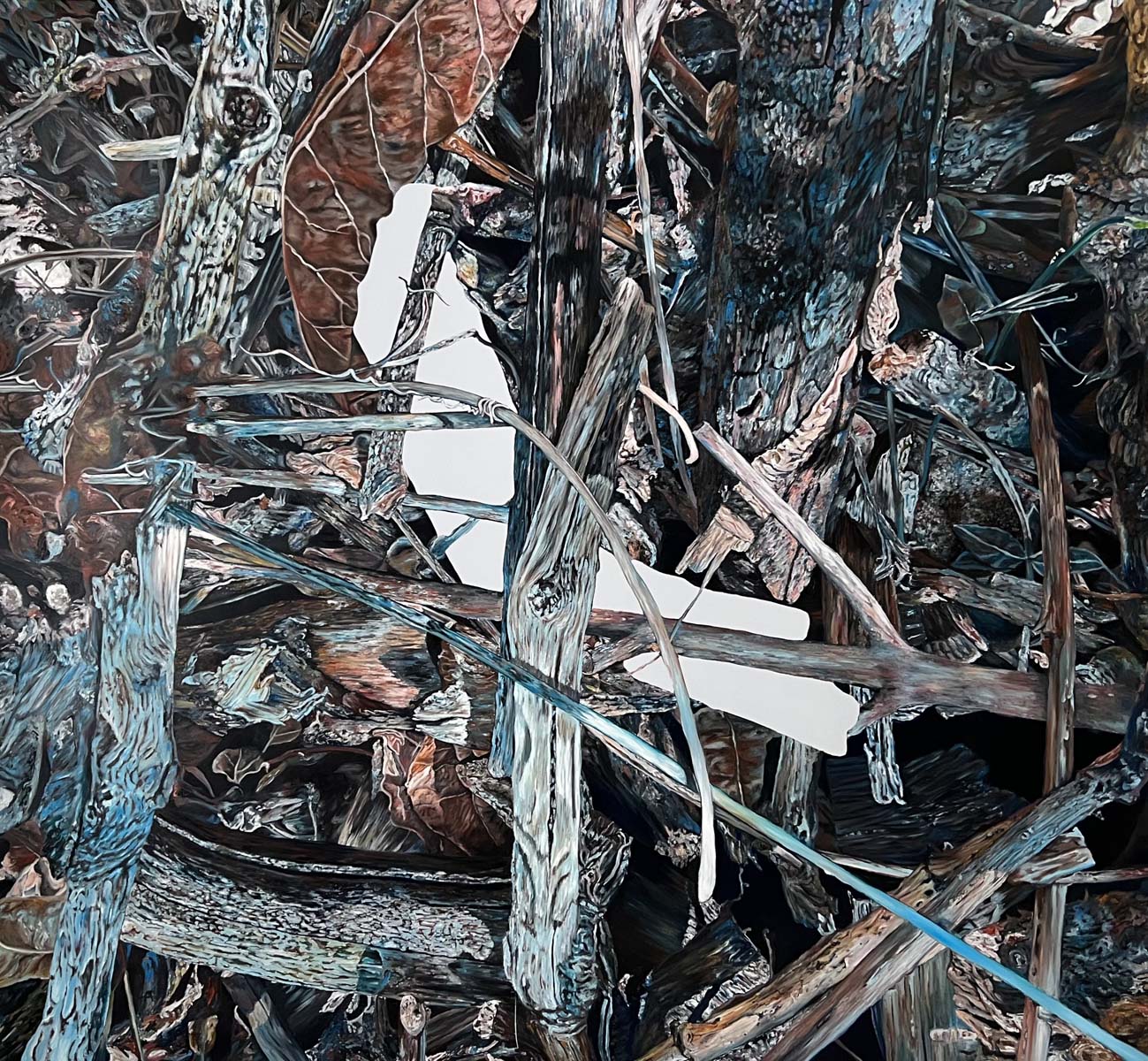
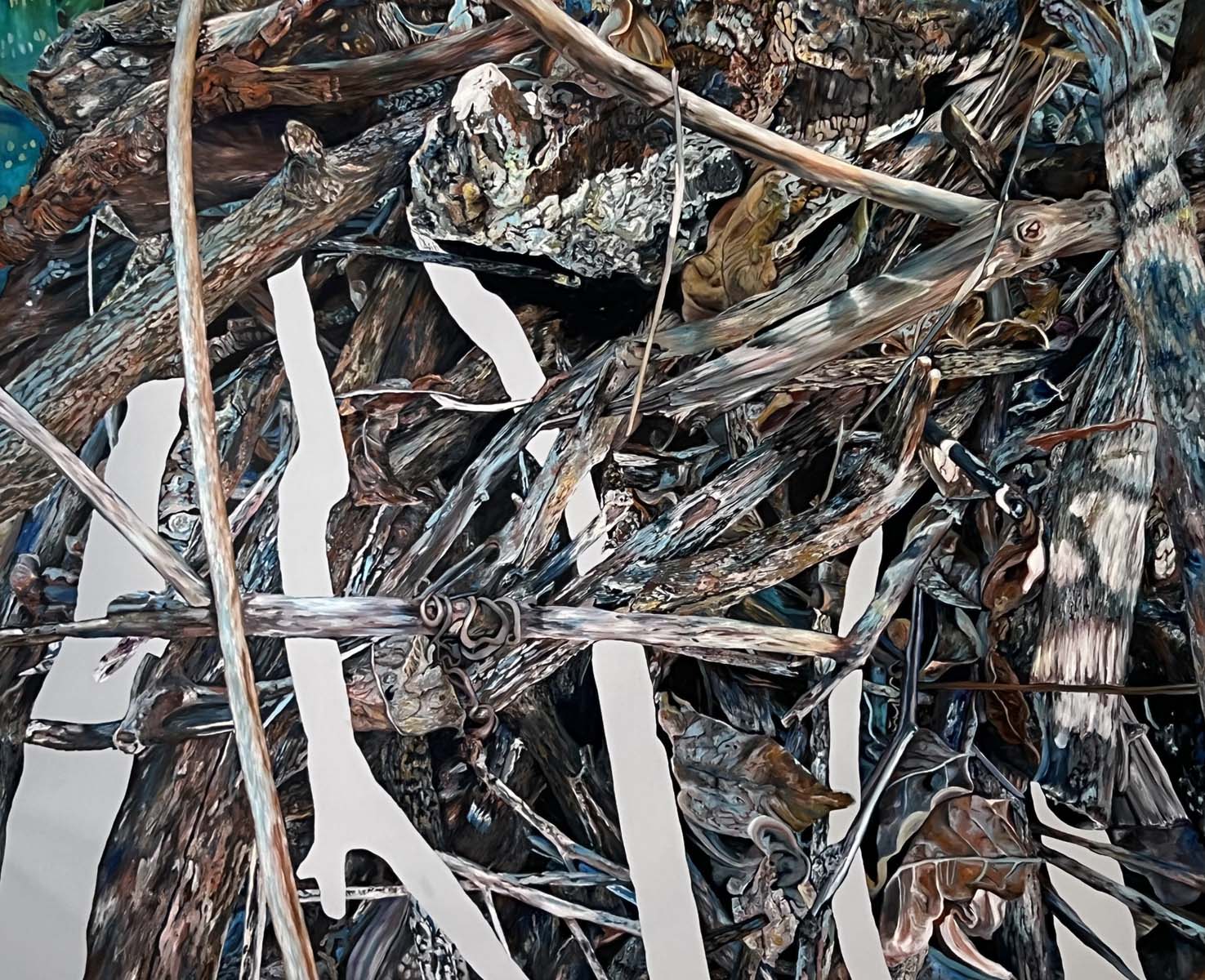
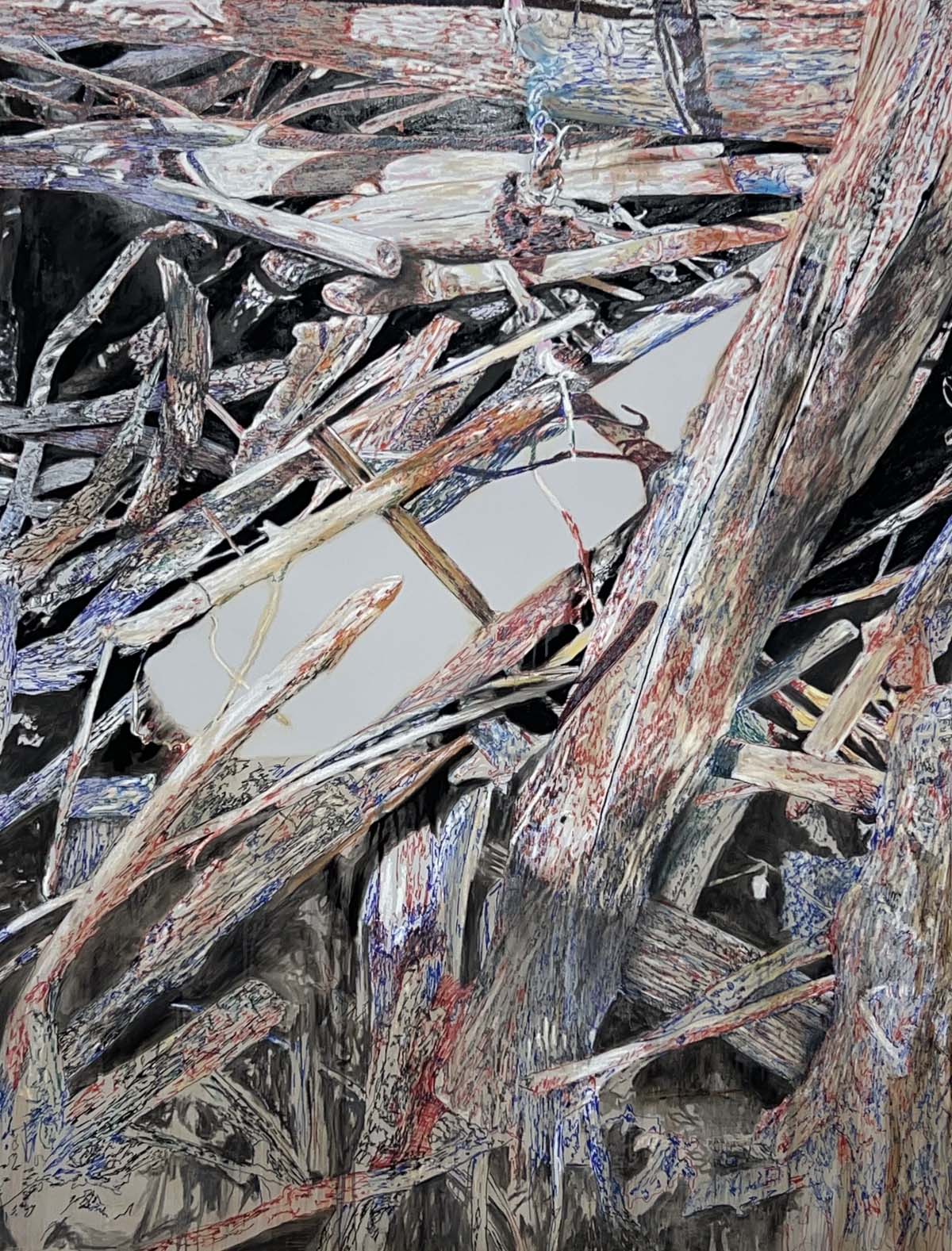
The starting point is a pile of twigs, now dry, noticed by the painter in his courtyard, “a domestic nature,” to use his words. In reality, there is very little nature… the twigs, if anything, are a memory of it. A still life that, thanks to Nicola Rotiroti’s artistic gesture, not only comes back to life but becomes the protagonist, immanent and preponderant, occupying the entire space of the canvases, as if to engulf the human element.
Nicola Rotiroti’s nature, therefore, has very little that is “natural,” even less that is domestic. It is inhospitable, psychedelic, and threatening. The color range, with acidic and cold tones, in a palette reminiscent of Mannerist altarpieces more than Pontormo than Rosso Fiorentino, seems to build a barrier that blocks the gaze and entry of the visitor. Then. The void.
As the eye glides over the canvas, exploring all its recesses, gaps suddenly open. Empty spaces, like chasms or passages. Entrances to another dimension that create a sense of vertigo and disorientation in the viewer. It is impossible not to think of the magical black hole that led Alice into Wonderland. Although here the context is different because the unnatural void opening on the canvas refers more to a digital reality than a natural one. And this hypothesis is confirmed by a statement of the artist, who, to describe these pauses in the pictorial fabric, speaks of “Induced Void. As if all human beings were simultaneously dazzled, retaining on the retina the memory of that light so strong that it made everything else disappear.”
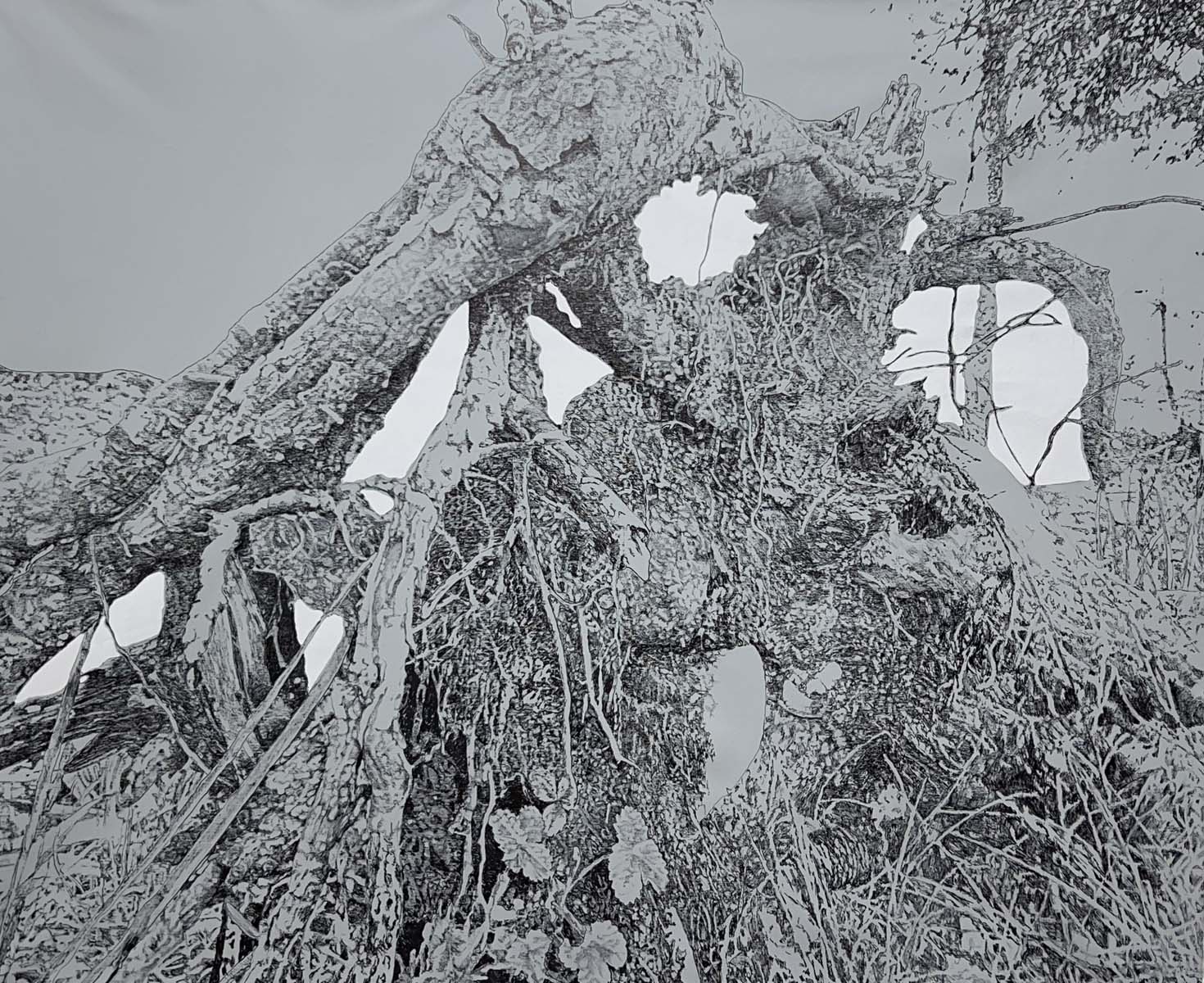
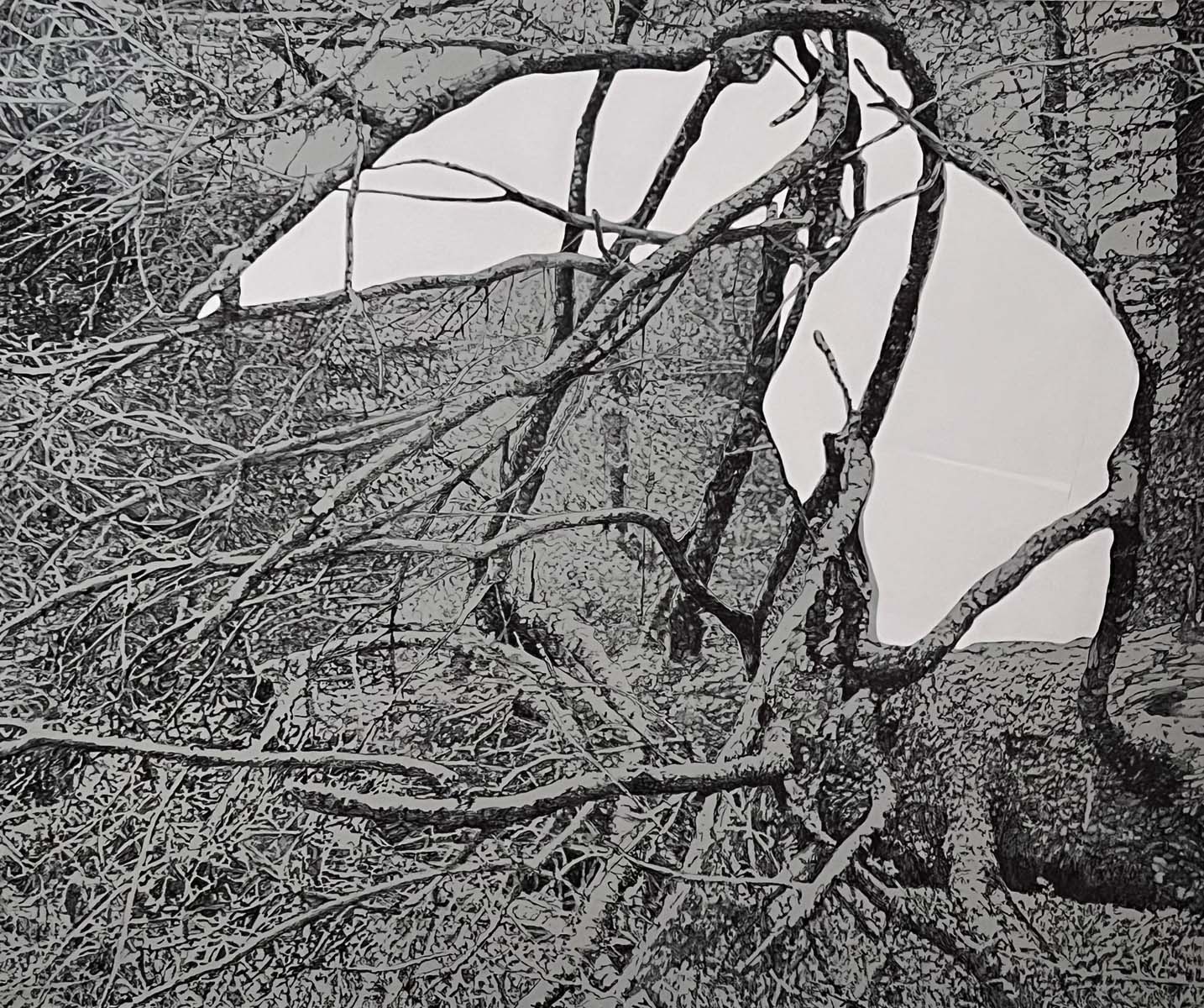
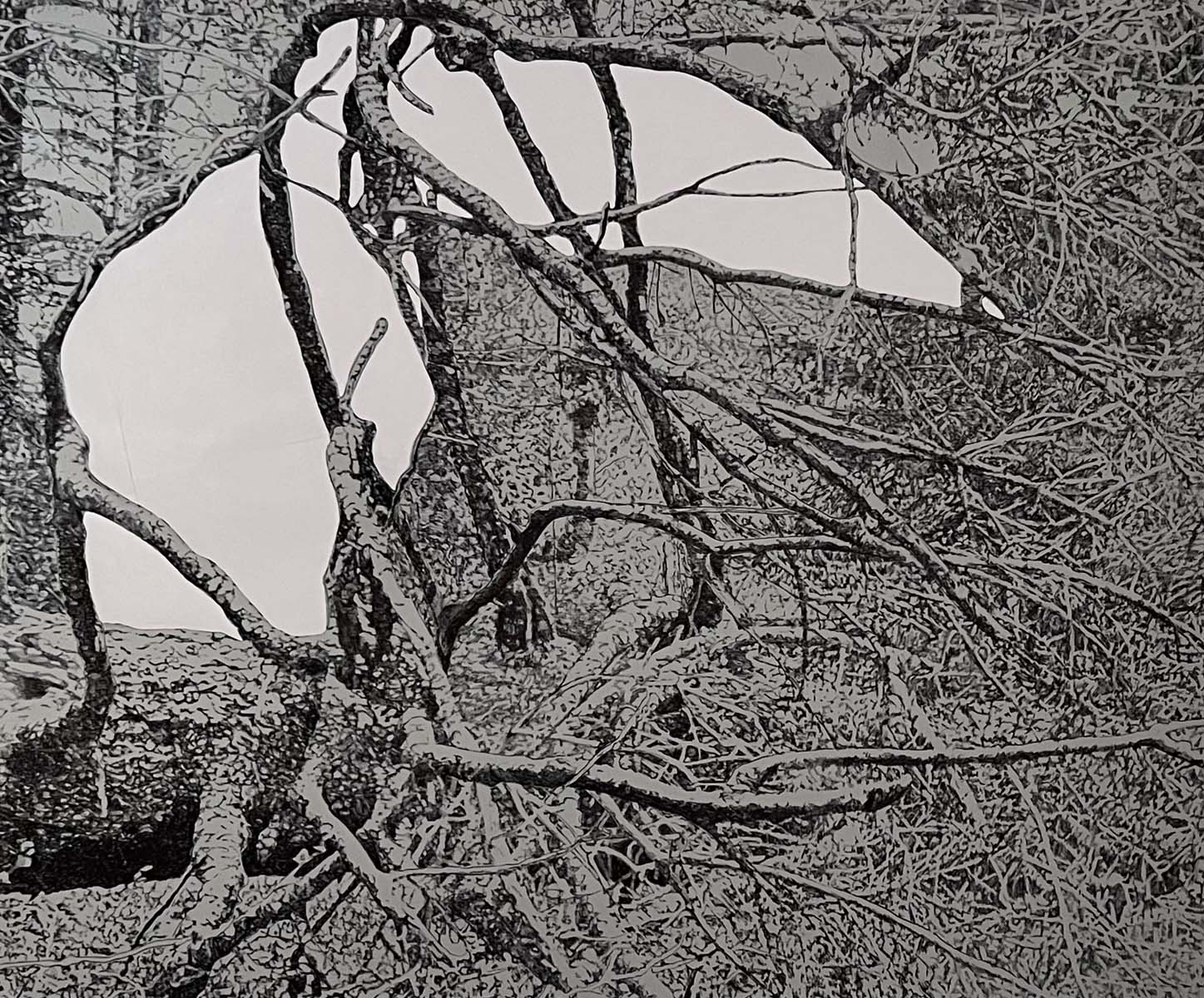
This element of suspension in the pictorial fabric, present as a constant in all the works, gradually expands until it becomes predominant in Migrante, one of the black and white pieces.
In the color works, which were made first, initially “the void” appears timidly, then becomes increasingly marked. And, since the void, as we know, does not exist in nature, for Nicola Rotiroti the void does not correspond to the canvas left in a preparatory state: an acrylic gray obtained by mixing different colors, but applied to a surface on the canvas using collage techniques that amplify and thicken this dimension of void. As if it became a resonance chamber of the work itself; a short circuit in the pictorial weave that indeed points to something else. This something else for the artist is the virtual world, the Metaverse, which he, little inclined toward technology, has struggled to accept and therefore perceives as a threat to the human, and particularly to that contemplative state typical of human beings.
The seven works of “Drawn from a True Story” can therefore also be read as a critique of the Metaverse, understood as a metaphor for innovation at all costs, as a pursuit of progress at the expense of humanity. Nicola Rotiroti’s works, the artist who admits he has struggled to adapt to the “technological revolution,” beyond appearances, have nothing digital and are the result of an entirely analog, slow, manual process. Made of preparatory studies, attempts, rethinking, and reflection; of oil paints that take longer to dry and require greater patience and awareness.
And if, as a whole, the exhibition opens the doors to a parallel, virtual reality, in which everyone can find their own references; the titles of the works, apparently incomprehensible and totally disconnected from context, open a window onto the unconscious world of the artist, whose calmness in work contrasts with the incessant, frantic movement of his thoughts which, in the phase of artistic creation, focus or rather condense in the form of keywords that, obsessively, like a mantra, accompany him until the conclusion of the work. These words arise in the painter’s mind completely randomly, from conversations, songs, or readings approached in physical or conceptual proximity to the work itself.
“Phrases that come back to his mind in a hammering, continuous, incessant way.”
It goes from the first, in order of creation, subtitled “Never Peace,” to “Paolo Uccello,” to the third “Lacking Half-Tones.” The last colored painting takes its name from an old Neapolitan neomelodic song by Nino D’Angelo “Popcorn and Chips,” while the black and white works are called “Migrante” and “Staedtler 2” and “Staedtler 3,” the other two taking the name from the brand of markers used by the artist to make the three monochrome works. “Migrante” is the only work that, in addition to representing the void, leaves ample space for what in my view could be a horizon. The canvas space, which I want to imagine, represents hope or, at least, a possibility to write the future differently.
Ludovica Palmieri
Following the Soul of Nature
The mystery of artistic creation is like the mystery of natural birth. A woman can love, desire to become a mother; but the desire for herself, however intense, cannot be enough. One day she will be a mother, without a precise warning of when it happened. Likewise, an artist, living, carries within himself many seeds of life and can never say how and why, at a given moment, one of these vital seeds inserts itself into his imagination to become a living creature on a plane of life higher than the mutable daily existence (Six Characters in Search of an Author, Luigi Pirandello).
The very different roles that art and its actors have played throughout history, with their progressive growing autonomy of functions and social spaces, have led us to forget the ethical nature of aesthetic practice. But in a world perceived as being in ever-growing crisis, many artists feel the inevitable obligation to recover that nature, showing a fully responsible attitude toward art and society, and why not, a salvatory one.
Among contemporary artists, few refer directly to Nature, but those who do generally show a vision much more intimate than real. They mostly assert the freedom not to confine themselves to any style or language, moving through the world through ideas, occasions, and images that at certain moments have breathed energy into their experiences and mainly into themselves. These natural visions have weight and presence: they impact and surprise us; they are alive, occasionally becoming a hotbed of symbols and allegories; they are simple but indisputably seductive, becoming our intimate and moral universe.
Nicola Rotiroti, in this large cycle of works entitled “Drawn from a True Story,” starts from observing some natural elements randomly accumulated in the garden of his studio (branches, leaves, bark) and transposes the personal narration of these elements onto large canvases. As the refrain of a well-known Jarabe de Palo song goes, “Depends, on what it depends? From which point you look at the world, everything depends.” In this case, the artist does not deal with nostalgia or memory; he does not compete with photographic reality, nor does he question how to represent naturalness. Art does not reproduce what is visible, but makes visible what is not always so. (Paul Klee)
He works without adhering to any neo-“ism” to connect to realism, symbolism, or impressionism; yet he evokes a sense of wonder and mystery in front of the visible world. This extraordinary series of works strikes us for its visual saturation: an overload of images that closes us within the natural cycles of birth, decay, and rejuvenation; cycles in which life rises from putrefaction. The beauty of the images opens the path through a primordial chaos that leaves the observer trapped. The general scene surrounds us with a physical presence, together with a palpable, potentially visionary sense that forces us to look through the intended monochrome voids; they are virtual doors that introduce us to the mysteries of natural light and to reexamine our memory. Lost in details, we get tangled in trunks and branches that—forcefully—push upward. In the midst of the tabula rasa, we undoubtedly feel the signals of an indomitable energy that resists any final act of surrender: Nature is painful, chaotic, and overpowering but, at the same time, solid, prolific, and versatile. These seven works by Nicola Rotiroti invite the viewer to traverse an inner landscape, where nature, artistic creation, and poetry intertwine, evoking the apparently elusive character of natural elements. “The nature of art is to show something that was previously unknown both in the reality that surrounds us and in the one inside us, we are in nature, we are nature, even our thoughts are part of nature, born from natural stimuli such as light, a plant growth structure, a contrast of natural colors, poppies in the wheat, wind in the rain; there is therefore a visual art that gives body and color to an aesthetic thought that was naturally invisible in the author’s mind, thus this form of art also allows others to see this aspect of nature” (Bruno Munari, “Art and Nature” 1983).
Their work, in which continuity and transformation are discussed, viscerally transforms art into a function of rebirth.
Massimo Scaringella
The Mental Expressionism of Nicola Rotiroti
The retinal and psychological experience of being immersed among large canvases on which stacks of mostly broken branches are painted, forming a very dense network, within which mutable voids of varying size and shape open, is unsettling. Unease is the mood suggested by this large, unique, threatening wave of painting that Rotiroti pours over us. It is not a forest, as it might seem at first glance; it is not the effort to naturalistically depict a wide stretch of Mediterranean scrub. The colors are not naturalistic, nor is the dense network of interlacing branches drawing an improbable and dysfunctional pattern. Nor are the deliberately arbitrary, illogical, disorienting incursions of white.
The painting of this artist, who has accustomed us to any surprise, while expressing great virtuosity, does not flaunt itself, does not perform a sterile show of self-indulgence. It is rather a mental operation, born of discomfort. Not occasional discomfort, however. Nor purely individual, the result of a single neurosis or pain. Rotiroti’s large vegetal surfaces seem to allude to a collective malaise. To a fragility of which each of us is part. The true story from which the author’s gamble is drawn is a story of everyone. It seems to speak of the two hundred thousand deaths from the pandemic. It seems to speak of piles of corpses from centuries of wars and the terrible one that even now reaps lives and heaps ruins not far from us.
It seems to me that the art of this gentle and restless creature goes beyond the technical skill it expresses, which is dazzling. It does so because it resonates with a trait of the human condition normally overlooked. We recount human triumphs and try to hide miseries. The story told is that written by the victors. And common sense, the key to interpreting current events, is never random, but an expression of a magma of interests. The prevailing common sense is that of the winning power groups. Today it tends to conceal the fragility and anguish we are soaked in. A resigned, feeble consumerist optimism must inevitably permeate our lives. And there is no space for the “pessimism of reason.”
There is no space for reflection on the meaning of our existence. On the very nature of our mortality. On the ontological character of our malaise and its very necessity within the logic of a becoming that does not question the naturalness of the human condition. This condition is today culpably removed. And Rotiroti denounces this removal, enclosing us within a claustrophobic microcosm that seems to inaugurate a new type of expressionism, more mental than related to the deformation of faces and bodies.
This author, in the prime of his maturity, is entirely contemporary because, unlike the far more numerous post-contemporary colleagues, he is still interested in reality as he observes it. And of reality he tells the features that serve as a stimulus for representing the obstacle that blocks vision. The lack of reference points on those walls of broken branches. The inevitability of incursions that tend to replace nature, as technology often does with the natural flow of conscious human relationships. This is why this author’s major exhibition is challenging. Not only for the large formats of the canvases that tell of the courage of one who does not want to spare himself, but for the even greater courage of staying grounded, in the face of the difficulty of growing one’s own roots.
To the natural, and “beautiful” in some ways, fragility that characterizes men and women, today is added an artificially induced fragility that men and women want to dominate. That is why the exploited no longer feel exploited, no longer rebel, mostly accept their destiny, attributing the reasons for their affliction to themselves. Or, more often, they live in a state of toxic hypoesthesia.
In this, painting is powerful and uncontrollable: in its ability to write treatises without the need for paper and pen, or paper and keyboard. Today Nicola Rotiroti, seizing our gaze, immersing us among the dense surfaces of his vegetal walls, has given us a journey into the awareness of the condition of everyone and each one of us. A condition made first of all of our limits, and then of the conditions that prevent them from becoming opportunities for redemption. As happened with the pandemic. As is happening with a war that risks becoming an apocalypse.
Roberto Gramiccia
